Home › Services › RCD Tripping & RCD Faults
An RCD that keeps tripping — or one that will not reset at all — is telling you that current is escaping to earth somewhere on your circuits. That is the device doing its job, not failing. We test to find the real cause: appliance, damp, damaged wiring, or the RCD itself. Emergency electricians, 24 hours a day, across East Sussex.
KNOW THE SIGNS

This is a diagnostic job, not a parts swap. The symptom — a switch that trips — is identical whether the cause is a failing kettle or a nail driven through a cable inside a wall. The work is finding out which, and the only reliable way is with test instruments.
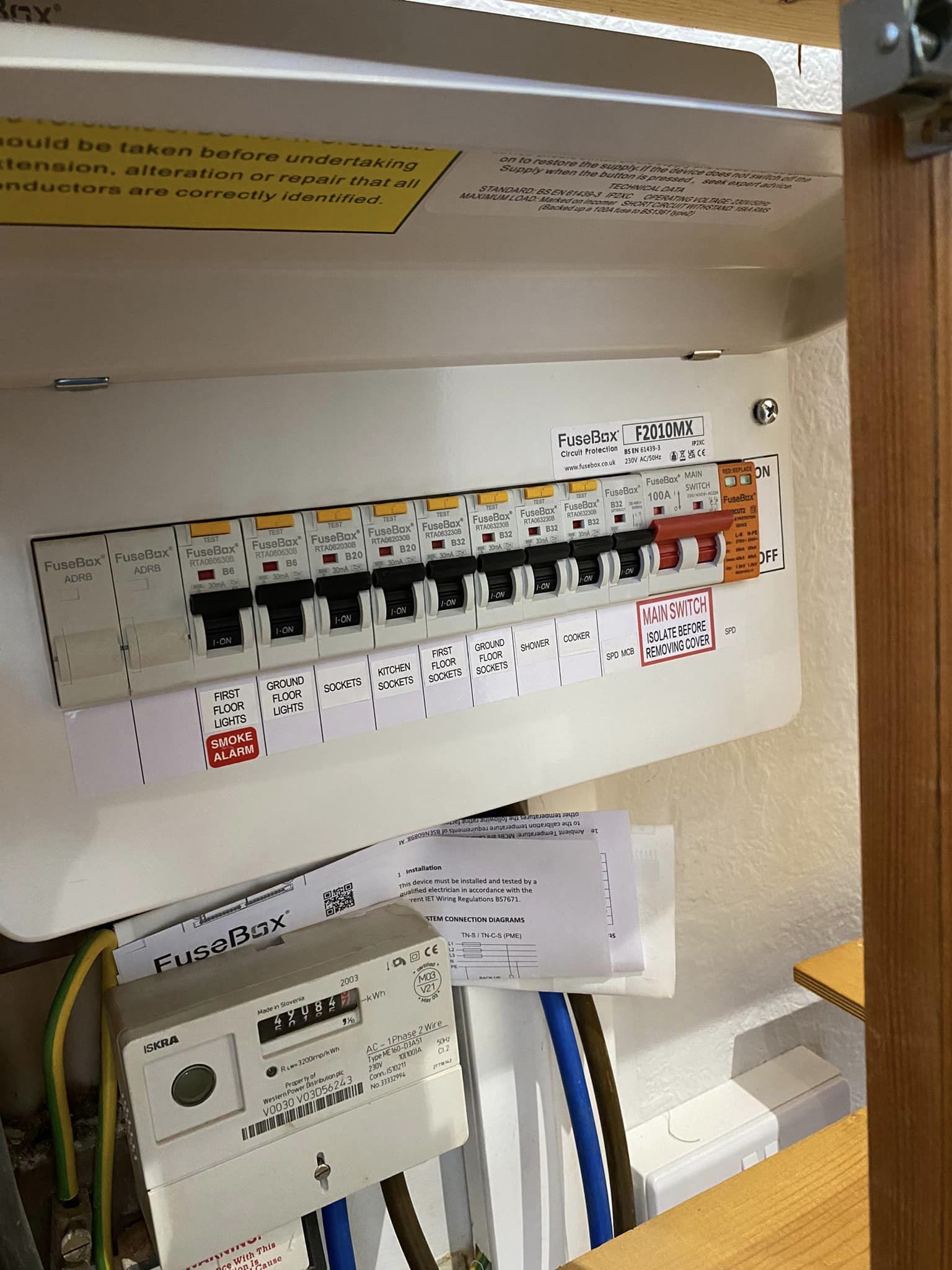
An RCD (Residual Current Device) is the wide switch in your consumer unit, usually with a T or Test button. It continuously compares the current flowing out along the live conductor with the current returning along the neutral. In a healthy installation those match, because electricity that goes out has to come back. If some is leaking to earth instead — through damaged insulation, a wet wall, a corroded heating element, or a person touching a live part — the two no longer balance. That difference is the residual current, and a 30mA device disconnects before it can seriously injure someone.
An MCB protects the cable from overload and short circuit. An RCD protects people from earth leakage, and usually covers several circuits at once. An RCBO does both jobs for one circuit. With a shared RCD, one fault takes out half the property and gives you no clue where it is. With RCBOs, one fault takes out one circuit — the board has told you where to look. It also matters which device has gone: if a single MCB keeps tripping while the RCD stays up, that points to an overload or a short circuit on that one circuit rather than earth leakage, which is a different search and is covered on our power loss and tripping page. Only testing can confirm what is happening in your installation.
PROBLEMS WE SOLVE
A fault is present right now: a solid earth fault, a neutral touching earth, water in a fitting, or a failed device. Because it is live, it is measurable.
Once a week, apparently at random. Usually cumulative leakage near the threshold, a thermal fault that shows only once something is hot, or a weather-dependent leakage path.
Sockets off, lights on — or the reverse. Typical of a split-load board: one circuit is faulty, and the whole bank behind that RCD goes down with it.
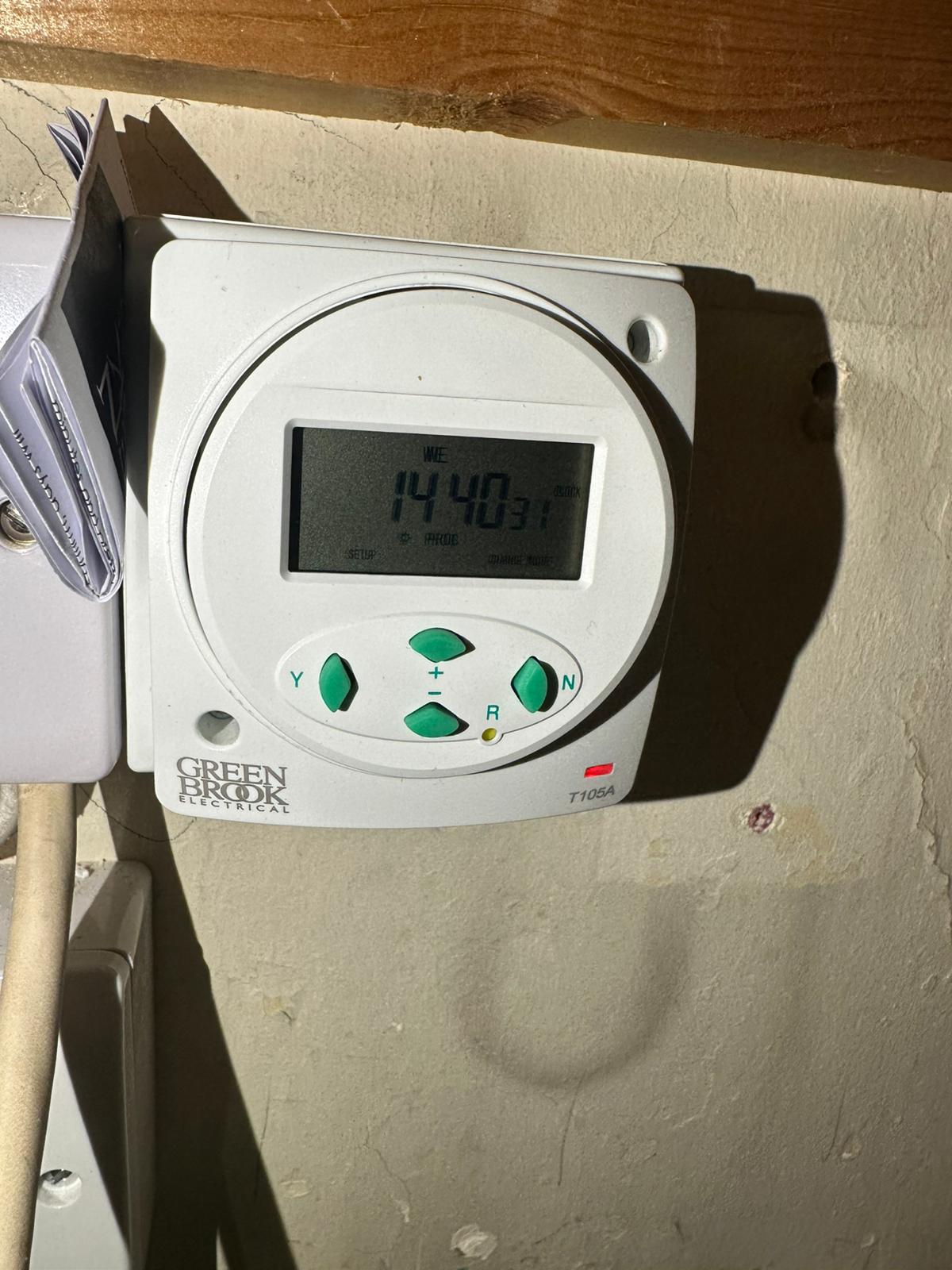
Off-peak immersion and storage heaters, timed outside lights, pond pumps and freezer defrost heaters run while you sleep. The load causing it is one you never see running.
Sometimes the device has drifted and lets go well below the current at which it should hold. Trip-time and ramp testing settle that with a number, not an opinion.
Landlords, HMOs, shops and offices, where a tripping RCD is a safety problem and a duty. We test, repair, certify and hand over the readings.
COMMON SYMPTOMS
A permanent fault behind that device, and it should not be forced. The consolation is that a fault present all the time is the easiest kind to measure.
Something is switching on unattended — an immersion or storage heater on an Economy 7 timer is the classic.
A high-power heating element in a wet environment. Elements often keep working perfectly while they leak, so the appliance gives no other sign of trouble.
Useful information: that rules out plug-in appliances and points at the fixed wiring, an accessory, a permanently connected appliance, or the RCD itself.
ROOT CAUSES
The most common cause by a distance. Washing machine heaters, immersion heaters, showers, oven elements and tumble dryers all use a resistance wire inside an earthed metal sheath. Once that sheath is breached, moisture reaches the insulation and current tracks to earth — while the appliance carries on working normally. Motors are the second group: pumps, extractor fans and freezers, where winding insulation degrades with age and damp.
Much modern equipment leaks a small, entirely normal amount of current to earth by design, through the filters used to suppress interference. Televisions, chargers, LED drivers, induction hobs and EV chargers each contribute a milliamp or two, and they add up behind one RCD. Good practice is to keep standing leakage to roughly a third of the device’s rating — about 9mA on a 30mA device. The remedy is to measure it and redistribute circuits across separate RCBOs, not to fit something less sensitive.
Outside lights, garden sockets, sheds, garages and buried armoured cable. The failure points are predictable: perished seals, unsealed cable glands, indoor junction boxes fitted outside, water tracking down inside a light fitting from a leaking gutter. It is weather-dependent because the leakage path only exists while things are wet — so a circuit tested on the first dry day in a week can read perfectly healthy.
A very common reason an RCD will not reset at all. If a neutral conductor touches earth — a screw through a cable, a stray strand against a metal back box — the return current divides between the neutral and the earth path, and the RCD sees an imbalance. A close relative is the borrowed neutral, where one circuit’s neutral has been used by another. Across a board with two RCDs that produces tripping which looks illogical until continuity testing traces it.
Nails and screws through cables behind plasterboard, rodent damage in lofts, cable crushed in a joist notch, older rubber-insulated wiring at the end of its life, and water leaking from bathrooms or roofs into ceiling roses and downlights.
RCDs come in types — AC, A, F and B. A Type AC device responds only to smooth alternating residual current, while much modern equipment produces residual current with a DC component, which can both cause unwanted tripping and reduce the device’s ability to trip when it genuinely should. Current BS 7671 requirements have moved away from Type AC for most applications. Devices also simply wear out.
OUR DIAGNOSTIC PROCESS
Not every step is needed on every job, but this is the shape of it. Every callout includes a visual inspection and circuit testing.
Where the fault sits deeper in the installation, the wider tracing process is covered on our electrical fault finding page.
WHEN YOU CALL
SAFETY FIRST
A smell of burning, hot plastic or a fishy odour near the fuse box, a socket or a switch. Any part of the board, a socket or a plug hot, discoloured or scorched. Buzzing, crackling or fizzing. Water reaching electrical equipment. Anyone feeling a shock or a tingle from an appliance, a tap or a metal fitting.
If there is fire or smoke, or anyone has been injured by a shock, call 999 first. If the whole street is dark it may be a supply fault rather than yours — check whether neighbours also have no power and call 105 free of charge to reach your network operator.
All of this is done from the front of the consumer unit, using the switches only. No cover comes off, no tools, nothing is dismantled. If you are not comfortable with any of it, skip it and call us.
The RCD cannot tell whether the leakage path it has measured is a damp brick wall, a corroded element or a person’s arm — it disconnects for all three, which is exactly what it is for. Reset once to check; if it trips again, leave it off and have it tested.
The right repair depends entirely on what the testing finds, so this is what these jobs typically resolve into rather than a prediction about yours.
Location: Hailsham
Customer's problem: The RCD would not reset at all, even with everything switched off.
Initial symptoms: RCD dropping the instant it was pushed up, with every breaker below it already off.
Tests performed: RCD proved with a ramp test, wiring at the board inspected, then neutrals lifted and tested individually.
Fault discovered: A borrowed neutral left behind by an earlier alteration — the upstairs lighting neutral had been landed on the wrong side of the board, so current was bypassing the RCD.
Repair: Neutral returned to its correct bar and the earlier alteration put right.
Final testing: RCD trip times at rated and five times rated residual current, plus insulation resistance across all circuits.
Outcome: RCD held first time. The customer was told the fault would have reappeared at any future board change.
CALLOUT PRICING
The callout charge is fixed and set by the time of day. Any additional work is quoted and agreed before it begins.
| Callout | When | Price |
|---|---|---|
| Basic callout | 9:30am – 3pm, not guaranteed within the hour | £110 |
| Day callout | Daytime | £130 |
| Early evening callout | Early evening | £180 |
| Overnight callout | Overnight | £250 |
Every callout includes a visual inspection and circuit testing. Parts and further repair work are quoted and agreed before that work starts.
24/7 EMERGENCY LINE
Tell us when it trips and what is running at the time, and we will tell you what we think is happening and what it takes to confirm it.
WHY POWER PROS
Replacing an RCD because an RCD is tripping is the most expensive way to not fix a problem. Experience of tracing leakage is what stops that happening.
City & Guilds qualified, Part P registered electricians, working to BS 7671 and current Building Regulations.
RCDs have an unhelpful habit of going at 2am and at weekends. We answer 24 hours a day, 7 days a week, and state a 1 hour response.
For an RCD fault that means measuring the leakage and dealing with it while we are there, wherever the fault allows.
Set by time of day and told to you before we travel, with a 100% satisfaction guarantee on all services.
Fully insured, and you are shown the readings that were taken rather than simply told it is sorted.
CUSTOMER REVIEWS
“Very happy with Aaron this service the electrician came out quickly within 1 hour and fixed a fault tripping out my electrics which turned out to be a water leak getting into a socket outlet. Highly recommended electricians.”— Alan, Google review
“Fast, reliable and genuinely professional service. The emergency electrician Harry diagnosed the issue straight away, explained everything clearly, and carried out the repair safely and efficiently. Pricing was fair with no hidden surprises, and the work was left neat and tidy.”— Steve, Google review
“Great service, we will use them again. 5 stars.”— Brian Hearn, Google review
Reviews from our Google Business Profile, rated 5.0 from 10 reviews. Read them on Google.
YOUR QUESTIONS ANSWERED
No. Resetting restores power to a faulty circuit and removes protection that was working correctly. The fault almost always gets worse, and repeated operation under fault wears the device. Reset once to check; if it trips again, leave it off and have it tested.
It is different, and often easier to fix. It means a fault is present right now: a solid earth fault, a neutral touching earth, water in a fitting, or a failed RCD. Because the fault is live it is measurable, which usually makes it a quicker diagnosis than one that trips twice a week.
Because something switches on unattended. Off-peak immersion and storage heaters on an Economy 7 timer, outdoor lighting on a timer or dusk sensor, pond pumps and freezer defrost heaters all run while the household sleeps. Overnight is also when outdoor accessories collect the most condensation.
Water has found a path to earth that only exists while things are wet. The usual points are outdoor sockets and lights with perished seals, unsealed cable glands, junction boxes fitted outside that were never suitable, and water in a cable duct. Once it dries the circuit can test fine, which is why this one is so often misdiagnosed.
Yes, and very commonly. A heating element is resistance wire inside an earthed metal sheath. Once the sheath is breached the insulation absorbs moisture and leaks current to earth, but the element still heats, so the appliance seems fine. A fault that appears only once the element is hot is the classic signature.
An MCB protects the cable from overload and short circuit. An RCD protects people from earth leakage, and typically covers several circuits at once. An RCBO does both jobs for one circuit only. With a shared RCD one fault kills half the property; with RCBOs, one fault kills one circuit.
Most people call the consumer unit the fuse box, so the first thing to establish is which switch has moved. The wide switch with a T or Test button is the RCD, and it normally takes several circuits down with it. The narrow single switches beside it are the circuit breakers, one per circuit. If one circuit breaker keeps tripping and the rest of the property is unaffected, the fault is confined to that circuit; if the wide switch will not stay up, current is leaking to earth somewhere behind it. All of that is read from the front of the board — no cover comes off, and nothing gets forced or held on.
Yes. RCDs are mechanical devices with contacts and, in some designs, electronics, and they age. A 30mA RCD must not operate at 15mA and must operate within 300 milliseconds at 30mA. One that has drifted and lets go early causes tripping that no circuit testing will explain. Trip-time and ramp testing settle it.
They can. Modern electronics leak a small, legitimate amount of current to earth by design. A milliamp or two each from televisions, chargers, LED drivers, induction hobs and EV equipment adds up behind a single RCD. Guidance is to keep that standing leakage to around a third of the device's rating — roughly 9mA on a 30mA RCD.
Not directly. An RCD protects against shock from earth leakage; an MCB protects the cable from overload and short circuit. Neither detects a series arcing fault at a loose terminal, which is a genuine fire risk. Any smell of burning or heat at a socket or the board is a separate and urgent problem.
Not necessarily, and anyone who says so before testing is guessing. Most RCD faults are on a circuit or an appliance, not the board. That said, if yours is a split-load type where one fault takes out half the property, or it is at end of life, individual RCBOs contain future faults to one circuit and make diagnosis quicker.
If the fault is present when we arrive and repeats reliably, it is usually a short job, because the leakage can be measured and attributed to a circuit straight away. If it is intermittent, weather-dependent or thermal, it can take considerably longer and may need monitoring or a return visit.
Rented property in England must have the electrical installation inspected and tested at least every five years, with a report provided to tenants and to the local authority on request. A repeatedly tripping RCD should be investigated promptly and documented, and the test results kept with the repair record.
MORE SERVICES
AREAS WE COVER
Power Pros cover Bexhill-on-Sea, Hastings, Eastbourne and towns right across East and West Sussex, 24 hours a day. Towns shown as a link have their own page; for anywhere else on the list, call 0333 360 8583 and tell us the postcode.
East Sussex
West Sussex
SPEAK TO AN ELECTRICIAN
The useful response is to find out what. Call us and we will tell you honestly what we think is going on, what it takes to confirm it, and what it costs before we start. Bexhill, Hastings, Eastbourne and all of East Sussex.
