Home › Services › Burning Smells & Dangerous Electrics
A burning or fishy smell, a hot socket, scorch marks or buzzing from the fuse box nearly always mean one thing: a connection running hot enough to damage itself. It will not correct itself, and your fuse box will not necessarily trip to warn you. Switch that circuit off if you safely can, then call us.
KNOW THE SIGNS
Smoke or flames, anything hot to the touch through a wall or ceiling, or a strong burning smell you cannot locate. Get everyone out. Fire keeps burning unseen inside wall and ceiling voids, and water must never go near anything electrical.
Call 999 as well if anyone has had an electric shock and is injured, unwell or was unable to let go. Do not touch a person who is still in contact with the electrics — switch the supply off at the consumer unit first if you can reach it safely.
Otherwise, if you recognise any of these, stop using that circuit and call 0333 360 8583.
An electrical burning smell is sharp and chemical, closer to hot plastic or a soldering iron than to burnt toast, and it tends to stay in one spot rather than drift through the house.
Most electrical faults can safely wait until morning. This one cannot: the fault causing the smell gets worse every hour the circuit is used.
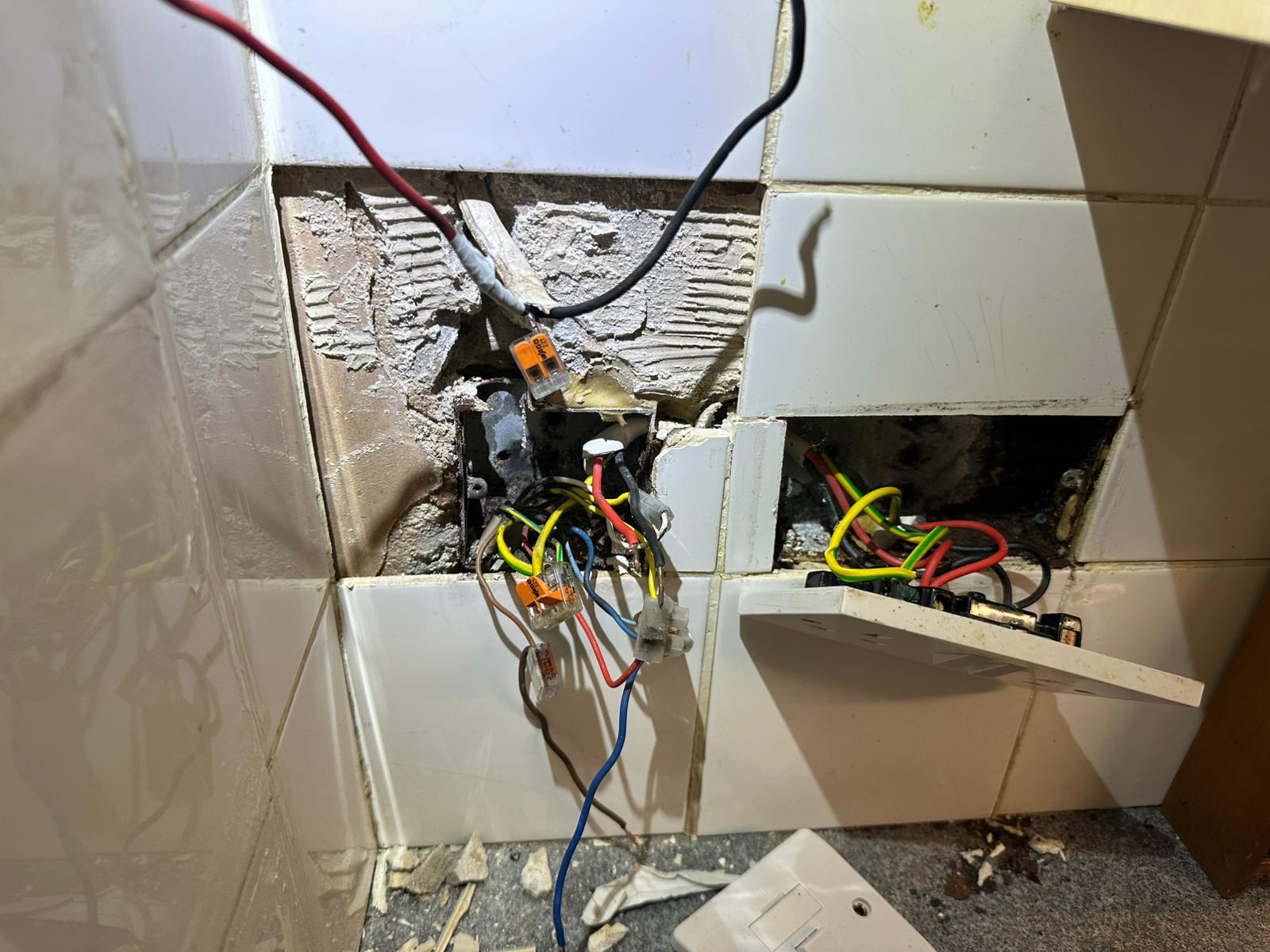
This is a distinct emergency service, not a general repair visit. The job is to find the point that is getting hot, prove whether anything else has been damaged, and make it all safe — in that order.
A burning smell from a socket is not always coming from that socket, and the visible damage is frequently not the fault. A scorched socket is commonly the victim of a loose connection at the socket feeding it. Replacing the burnt part without testing the circuit that damaged it destroys the evidence and leaves the cause in place.
We will not diagnose your installation over the phone, and you should be wary of anyone who does. What we can do on the phone is tell you what to switch off.
24/7 EMERGENCY LINE
Switch that circuit off at the consumer unit if it is safe to do so, then call. Bexhill-on-Sea, Hastings, Eastbourne and all of East Sussex, 24 hours a day.
PROBLEMS WE SOLVE
Usually a loose or degraded connection inside the socket, at a spur, or at the socket feeding it.
People often hunt for a dead mouse for days before realising it is the wiring.
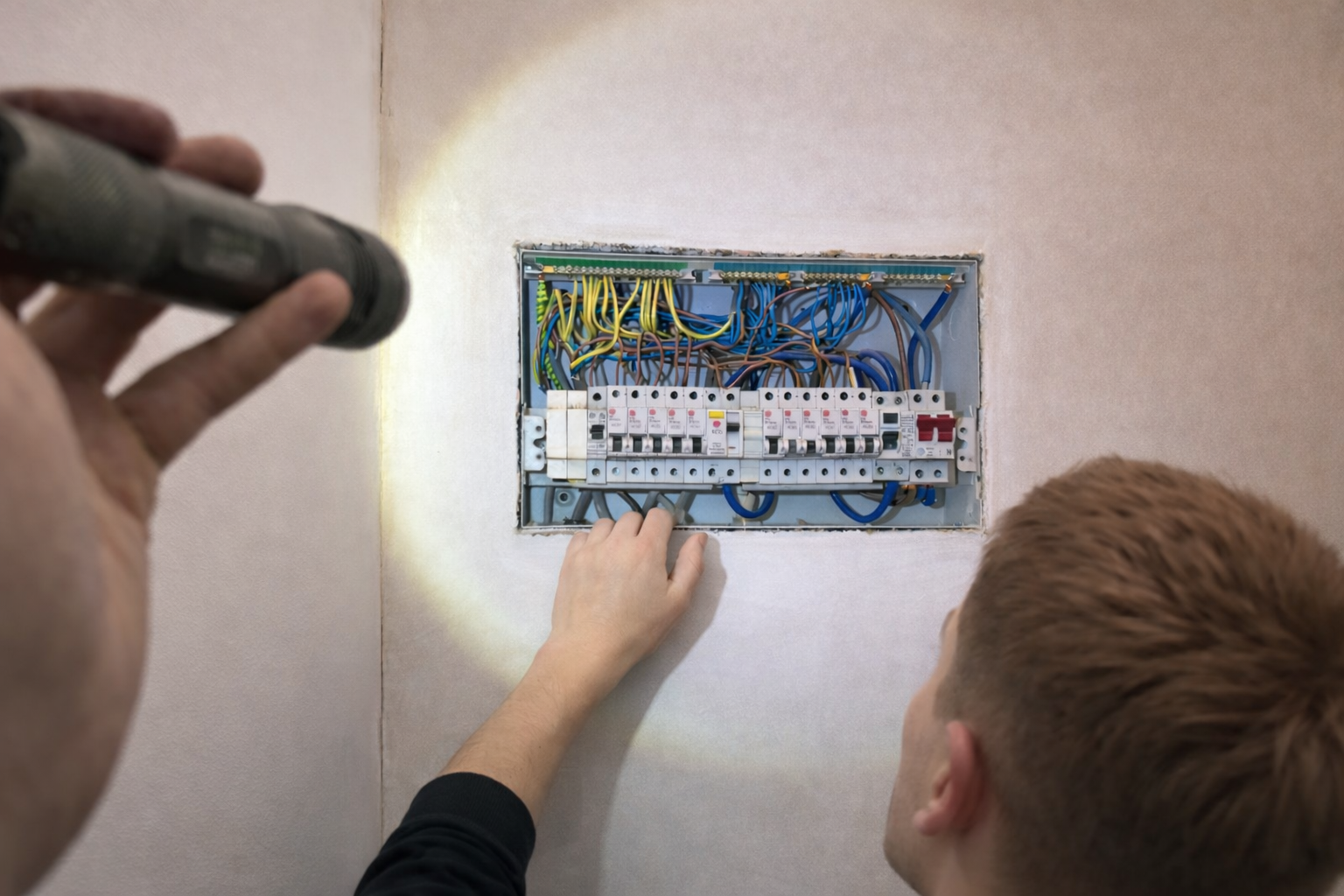
The whole installation's current passes through a few connections at the main switch, busbar and neutral bar. A loose one runs hot without tripping anything.
High resistance where the pins meet the socket contacts, usually on heavy loads: heaters, kettles, tumble dryers.
A brief spark as contacts make or break can happen. Sparking that repeats at the same socket, or any flash or bang, is a fault — stop using it.
High-current accessories carry heavy sustained loads, so a marginal connection shows itself here first.
Failing LED drivers, aged lampholders, loose terminals at a ceiling rose, downlights buried in loft insulation.
Motor windings and heating elements smell burnt when they fail. Proving it stops you paying to chase a fault that leaves with the tumble dryer.
"There's a fishy smell but there's no fish."
Accessory plastics and cable insulation contain flame-retardant additives. Heated past their design temperature but not hot enough to burn, they break down and release compounds people describe as fishy or ammonia-like. That smell means plastic somewhere is being cooked well past the temperature it was designed to run at — a warning, not an all-clear.
"The socket's hot but everything still works."
Heat at a high-resistance joint does not stop the circuit working; it wastes energy as heat at the bad connection. A charger being warm is normal. A socket faceplate getting warm is not.
"There's a buzzing noise coming from the socket."
An electrical buzzing noise at a socket, switch or dimmer is usually current arcing across a joint that is no longer tight. Some dimmers and transformers hum quietly by design; a noise that is new, or getting louder, is not one of them. A buzzing socket that is also warm or discoloured is the same fault as a burning smell, caught slightly earlier.
"It smells of burning but nothing has tripped."
An MCB looks for too much current; an RCD looks for current leaking to earth. A loose connection causes neither, so neither device sees anything wrong — the only device that watches for arcing itself is an AFDD, and very few homes have one. That is precisely why loose-connection fires happen. Believe the smell, not the fuse box.
"It smelled of burning for a while, then stopped."
The most dangerous version, because the smell usually stops when the load is switched off rather than when the fault clears.
INSIDE THE WIRING
Nearly every overheating fault in fixed wiring follows the same sequence.
Two harmless causes, honestly: dust burning off heating elements when the heating first runs after summer, and a new appliance burning off manufacturing residues. Both fade as the residue burns off, and neither is localised to one socket or accessory. Anything that persists, recurs, or comes with heat or noise should be treated as a fault.
FAULT DIAGNOSIS
STEP BY STEP
STAY SAFE
The meter, the supplier's main fuse (the "cut-out"), the service head and the sealed tails belong to your network operator and must not be touched without their authorisation. 105 is free from any phone and they treat this as an emergency.
Mains gas is odourised to smell of rotten eggs, not fish. If you suspect gas, do not touch any electrical switch at all — leave the property and call the National Gas Emergency Service on 0800 111 999.
Never remove a socket front, switch plate or light fitting. Not for a quick look, and not with the breaker off. Until it is proved dead with test equipment, it is not proved dead.
Never open the consumer unit cover. Parts inside stay live even with the main switch off.
Never keep resetting a breaker where there is a burning smell, never pull hard on a plug that has melted into a socket, and never carry on using the circuit because the smell has faded.
Leave the affected circuit off until it has been inspected and tested, even if the smell has gone. If it came from the fuse box, or you cannot tell which circuit it came from, leave the whole installation off at the main switch. And if you have decided the property is not safe to sleep in, act on that instinct.
REPAIR OPTIONS
The right repair depends entirely on what inspection and testing reveal. These are the outcomes we most commonly arrive at.
Where a terminal has worked loose but nothing is damaged, conductors are cleaned back to sound copper and the joint remade correctly.
A scorched socket, switch or connector block is replaced and heat-affected conductor cut back. See socket repairs.
Where the conductor itself has overheated, its insulation is degraded well beyond the point you can see, even where it still looks sound. Damaged electrical cable is replaced, not patched.
Remaking busbar connections or replacing a damaged MCB or RCBO — see fuse box repairs. Where the board itself is heat-damaged, replacement is usually the answer.
If genuine overload caused it, the fix is a dedicated circuit for the heavy appliance, not a new part on the same overloaded one.
The danger is removed, the affected part isolated and labelled, the rest of the installation restored, and the further work quoted.
Where one badly made connection turns up, others were often made by the same hands. An EICR tests the whole installation and is often the sensible next step, particularly for landlords.
CASE STUDY
Location: Newhaven
Customer's problem: A fishy, hot-plastic smell near the consumer unit, with nothing tripped.
Initial symptoms: Smell strongest at the board, one breaker warm to the touch, and no visible damage from the front.
Tests performed: Thermal check while still energised and loaded, then safe isolation and inspection of every termination.
Fault discovered: A high-resistance connection at the cooker circuit breaker. The terminal had oxidised and was running hot enough to cook the surrounding plastic, at a current well below anything that would trip it.
Repair: Breaker replaced, conductor cut back to clean copper and the terminal torqued correctly.
Final testing: Thermal re-check under load, earth fault loop impedance and RCD trip time.
Outcome: Smell gone and the board cool. The customer was shown why nothing had tripped, which is the part people find hardest to believe.
An illustrative example of a typical call-out of this kind.
CALLOUT PRICING
Nobody can quote the repair before seeing it, because "a burning smell" is a symptom, not a job — it can be a ten-minute remake of one terminal or a full circuit replacement. What we can be straight about is the callout, which is a fixed price set by time of day.
| Type of callout | Fixed price |
|---|---|
| Basic callout, 9:30am to 3pm (not guaranteed within the hour) | £110 |
| Day callout | £130 |
| Early evening callout | £180 |
| Overnight callout | £250 |
Any additional work beyond the callout is quoted and agreed with you before it begins.
FIXED CALLOUT PRICES
You will be told the callout price and a realistic arrival time on the phone, and the cost of any further work before it starts.
WHY POWER PROS
It is attended as a fire risk, not filed alongside "a socket has stopped working", and made safe before anything else.
Every callout includes a visual inspection and circuit testing, because the cause is frequently the connection feeding the part you can see.
Heat damage hides behind faceplates that look perfect. 85% of emergency callouts are resolved on the first visit.
City & Guilds qualified, Part P registered electricians. Work is tested to BS 7671 and current Building Regulations.
Fully insured, with a 100% satisfaction guarantee — which matters when the work concerns a fire risk in your own home.
Bexhill-on-Sea, Hastings, Eastbourne and all of East Sussex, around the clock, with a 1 hour response. The basic callout is the one exception.
CUSTOMER REVIEWS
“Aaron arrived quickly and was very methodical in his approach. He made sure a safe temporary fix was in place before leaving. He was honest about the issue being outside his scope and clearly explained the next steps to resolve it.”— Vickki Loverage, Google review
“I had a sudden electrical fault late in the evening and Power Pros came to the rescue. From the first call they were professional, calm and very reassuring. The electrician arrived quickly, clearly explained what the issue was, and got everything safely sorted without any hassle.”— Jane Baker, Google review
“Power Pros provided an excellent service from start to finish. They responded quickly, arrived when they said they would, and got straight to diagnosing the problem. Everything was explained clearly, with no pressure or hidden costs, which was really reassuring in an emergency situation.”— Tina, Google review
Reviews from our Google Business Profile, rated 5.0 from 10 reviews. Read them on Google.
COMMON QUESTIONS
Not always — dust burning off a heater at the start of the heating season smells of burning and then stops. But a smell localised to a socket, switch, light fitting or fuse box, or one that persists or returns, should be treated as dangerous until testing proves otherwise.
Flame-retardant additives in accessory plastics and cable insulation break down when overheated and release volatile compounds people describe as fishy or ammonia-like. Older urea-formaldehyde and phenolic accessories produce it strongly, as do failing suppression capacitors inside appliances.
Yes, if you can do it safely. Switch off the affected circuit using the labelled MCB or RCBO, or the main switch if you cannot identify it. Operating the front switches is safe; opening the board is not. If there is smoke or fire, leave and call 999 instead.
No. An MCB detects overload and short circuit; an RCD detects current leaking to earth. A loose connection causes neither, so neither device sees anything wrong. Loose-connection fires happen precisely because nothing trips.
Yes. The smell almost always stops because the load was switched off, not because the fault cleared. Heat raises resistance, which raises heat further, and that only runs one way. It will return, and it will be worse.
If you have isolated the affected circuit and there is no remaining smell, heat or smoke, most people would consider that reasonable — but nobody can judge your property from a web page. If the smell persists after isolation, or you cannot locate it, switch the whole installation off and call 999 for advice.
It means a connection carrying serious current is running hot, and it is treated as urgent. Every circuit in the property passes through a handful of terminals at the main switch, the busbar and the neutral bar, and a loose one there heats up without tripping anything. Switch the installation off at the main switch if you can do that safely, leave the cover closed, and call us. If the smell is actually at the meter or the supplier's sealed fuse beside it, that is your network operator's equipment — call 105.
Your electricity network operator, not an electrician. Call 105 free from any phone and it routes you to the operator for your area. The service head, cut-out fuse, meter and sealed tails are their equipment and must not be touched without their authorisation.
Please do not. The burnt socket is often the symptom rather than the cause, and replacing it destroys the evidence needed to find the real fault. It also needs testing afterwards to confirm the circuit behind it is sound.
We answer 24 hours a day, 7 days a week across Bexhill-on-Sea, Hastings, Eastbourne and East Sussex, with a 1 hour response on emergency callouts. The callout is fixed: £110 basic (9:30am to 3pm, not guaranteed within the hour), £130 day, £180 early evening, £250 overnight. Additional work is quoted first.
Usually not. Most overheating faults are a single bad connection and a local repair. Rewiring becomes sensible where the cable insulation itself is failing through age, or the same defects turn up repeatedly. An EICR is how you find out which you have.
Avoid high-load appliances on multi-way adaptors, fully unwind extension reels before use, buy plugs and chargers from reputable suppliers, and have heavy appliances put on their own circuits. Periodic inspection is the only way to find a loose connection before it announces itself.
RELATED SERVICES
AREAS WE COVER
Power Pros cover Bexhill-on-Sea, Hastings, Eastbourne and towns right across East and West Sussex, 24 hours a day. Towns shown as a link have their own page; for anywhere else on the list, call 0333 360 8583 and tell us the postcode.
East Sussex
West Sussex
EMERGENCY RESPONSE
The fault causing a burning smell gets worse every hour the circuit is used, and your fuse box will not necessarily warn you. Switch the circuit off if it is safe, then call. If there is smoke, flame, or heat you can feel through a wall, get everyone out and call 999 first.
