Home › Services › Fuse Box / Consumer Unit Repairs
A breaker that will not reset, a smell of hot plastic, a buzz you can hear from the hallway — the board is telling you something. Power Pros repair faulty consumer units and older fuse boards across East Sussex, 24 hours a day. Call and describe what you can see, hear and smell, and we will tell you what to do next.
KNOW THE SIGNS
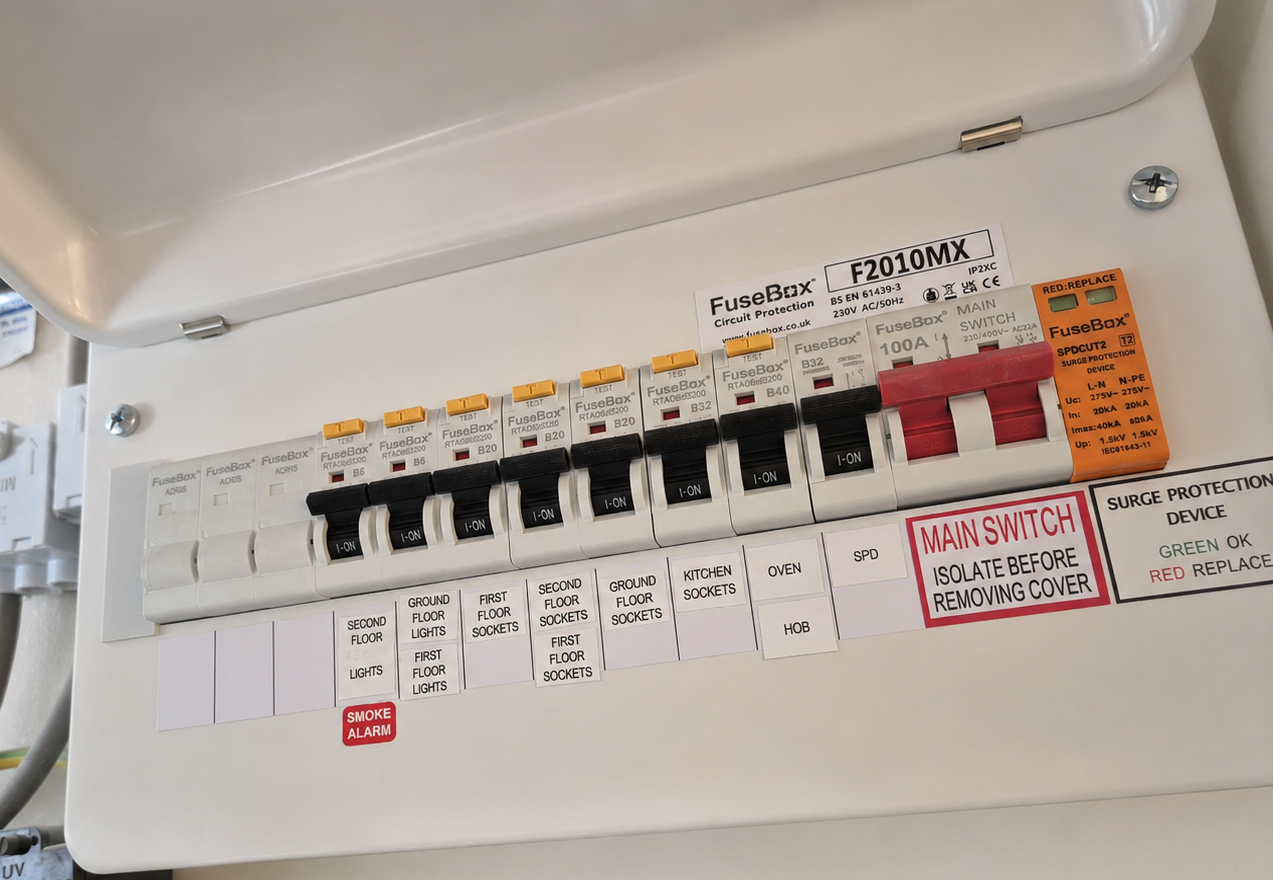
Your fuse box — properly a consumer unit on anything modern — holds the main switch that isolates the installation, the MCBs that protect each circuit against overload and short circuit, and usually RCDs or RCBOs that cut the supply within milliseconds if current starts leaking to earth. That last function is what stands between someone touching a faulty appliance and a fatal shock.
Repairing a board means correcting a fault in the unit itself or its connections rather than replacing the whole assembly: remaking an overheated termination, fitting a manufacturer-approved replacement for a failed device, or safely isolating one faulty circuit so the rest of the property keeps power while a permanent fix is arranged. It also means being honest about where repair stops being sensible — a new part in a heat-damaged or obsolete board is money on borrowed time. If yours needs replacing we will say so and show you why, and that is a different job, covered on our consumer unit replacement page.
The board stays live even when everything is switched off: the main switch does not de-energise the tails coming in from the meter. And the symptom rarely sits where the fault does. A breaker that “keeps tripping” may be a healthy device doing its job, or a worn one letting go far below its rating. An RCD dropping out every few days is usually reporting a real fault out on the circuits rather than a fault in itself — see RCD tripping and RCD faults. Only testing separates them.
WHAT WE FIX
Either it is protecting you from a live fault downstream, or the mechanism has failed. Only the second is a board repair. Forcing it back on repeatedly can weld the contacts closed, at which point the device protects nothing at all.
Discolouration at a terminal is the signature of a high-resistance joint. A loose connection carries the same current through a poorer contact area, which makes heat, which oxidises the metal, which raises resistance further. The process accelerates itself and it ends in fire.
A fuse box buzzing with a faint, steady hum may be no more than an ageing device’s mechanism. An irregular buzz or crackle usually means arcing — current jumping a gap at a loose terminal or a breaker not fully seated on the busbar. Arcing is intermittently very hot and is a real ignition source.
Every time a circuit heats under load and cools again the conductor moves fractionally against the screw, and over years that backs the connection off. We check terminations for heat damage and remake them to the manufacturer’s stated torque, not by feel.
An MCB is mechanical and has a finite life; a worn one may trip well below its rating, or fail to trip at all. An RCD whose test button produces no response has failed and is giving no protection whatsoever, while looking entirely normal.
A device not pushed fully home makes reduced contact with the copper busbar, and that junction heats and arcs. A main switch that will not hold is serious — it is your only means of isolating the installation. Cracked casings and missing blanks leave live parts reachable.
BS 3036 rewireable and BS 1361 cartridge boards are still common in East Sussex housing. Carriers crack and contacts corrode, and these are repairable where parts exist — but we will be honest about what you are and are not getting.
HEARD ON THE PHONE
Overheating insulation and phenolic mouldings give off a distinctive acrid, sometimes fishy smell. If you can smell it, heat has already been produced for some time. Treat it as urgent rather than waiting to see whether it worsens.
Tell us whether it is a steady hum or an irregular crackle, and whether it gets louder when a particular appliance runs. The shower and the oven are the usual suspects, because they draw most current and show up a poor connection first.
Under heavy sustained load a breaker running slightly warm may be normal. Noticeably hotter than its neighbours carrying similar load is not, and it points at that device or its connections.
On a rewireable board that means a genuine overload or a fault on that circuit. Fitting thicker wire to stop it blowing is extremely dangerous: the fuse element is deliberately the weakest point, and upsizing it makes the cable buried in your wall the weakest point instead.
Tell us which switch it is and what has gone off with it. A single breaker that flicks straight back down is nearly always reporting a live fault on that circuit, and it will keep refusing until the fault is found and cleared. Do not keep forcing it — repeated attempts can weld the contacts closed.
First question is whether the supply has been lost or the installation has — power loss and electrical tripping covers how to tell, including checking whether neighbours are off and calling 105. If the main switch itself will not hold, that is a board fault.
ROOT CAUSES
The biggest single cause. Screws back off through thermal cycling and vibration, some were never tightened properly, and some were over-tightened and have crushed the conductor strands.
A breaker not pushed fully home makes reduced contact with the busbar comb, and that junction heats and arcs. Common in boards where circuits have been added over the years by different hands.
Springs weaken, contacts pit and erode with every operation, lubricants dry out. A device that has tripped hundreds of times over twenty years is not the device it was.
Boards in garages, cellars and coastal properties suffer. Salt-laden air along the East Sussex coast is harder on terminations and enclosures than inland air, and it attacks contact surfaces first.
A board specified for a 1970s household now runs an electric shower, an induction hob and possibly a car charger. Devices run closer to their limits for longer, and heat accumulates at every marginal connection.
Most fuse board tripping starts out on the circuits, not in the board: water ingress, a failing heating element, deteriorated insulation, a nail through a cable. The board is doing exactly what it was designed to do — see electrical fault finding.
24/7 EMERGENCY LINE
Describe what you can see, hear and smell. We will tell you whether it can wait, whether you should isolate the supply, or whether we need to be with you now.
TESTING NOT GUESSING
Diagnosis comes before any part is fitted. “Just swapping the breaker” is how a genuine loose-connection fault gets left in place behind a shiny new device.
STEP BY STEP
STAY SAFE
Get everyone out. A fire inside a consumer unit develops quickly, and the board is very often in a hallway or under the stairs — on the escape route. Call 999 too if anyone has had an electric shock, however well they seem afterwards.
Never remove the cover of a fuse box or consumer unit. The incoming supply stays live whatever position the main switch is in, and it is not protected at any level that offers you protection.
Never keep resetting a device that will not hold, and never wedge or tape a breaker in the on position.
Never fit thicker fuse wire, a higher-rated fuse or a bigger breaker to stop something blowing. The device is sized to the cable behind it — upsize it and the cable in your wall becomes the fuse.
Never touch the sealed cut-out where the supply enters the building, the one with the wire and lead seal. It belongs to the network operator, the fault levels there are lethal, and interfering with it breaches your supply terms.
Never throw water at an electrical fire or try to fight one at the board.
More warning signs that mean stop and call immediately: burning smells, overheating and dangerous electrics.
What follows depends entirely on what inspection and testing reveal, and none of it can be promised before the board has been seen.
Where the damage is confined to the joint, the repair is to isolate, cut back heat-damaged copper and insulation to sound material, and remake the connection to the correct torque. Where a conductor has been shortened there must be enough length left to reach without strain — sometimes there is not, which changes the job.
A failed MCB, RCD, RCBO or main switch replaced with the correct device — and “correct” is doing a lot of work in that sentence. A consumer unit is a type-tested assembly, certified as a complete product under BS EN 61439-3 with enclosure, busbar and devices together. Another maker’s breaker may clip on and appear to work, but it invalidates that certification and is not a compliant repair. This is why sourcing the right part occasionally takes a day or two.
On some boards individual MCBs can be replaced with RCBOs, combining overload, short-circuit and earth-leakage protection in one module. Where the design permits it, this is often an excellent repair for a property plagued by nuisance tripping, because each circuit then trips independently instead of taking half the house down.
Where a repair cannot be finished on the visit — a part needs ordering, or the network operator must isolate at the cut-out — we can usually isolate and safely terminate the affected circuit and restore power to the rest of the property.
We recommend replacement when no compatible or manufacturer-approved spare can be sourced; when the busbar, base or enclosure has itself been cooked; when the measured prospective fault current exceeds the devices’ breaking capacity; when the board gives no RCD protection at all on circuits that current standards say need it; or when a repair would cost a meaningful fraction of a new board and buy you a year. In those cases see consumer unit and fuse box replacement.
Location: Rye
Customer's problem: Buzzing from the fuse box and a warm smell in the hallway.
Initial symptoms: An audible buzz at the board, one breaker warm to the touch, and lights dimming whenever the kettle ran.
Tests performed: Thermal check under load before anything was dismantled, then safe isolation and a torque check on every termination.
Fault discovered: A loose busbar connection at the main switch. The terminal was discoloured and the busbar pitted from arcing.
Repair: Main switch and affected MCB replaced, busbar section renewed, and all terminations torqued to the manufacturer's figures.
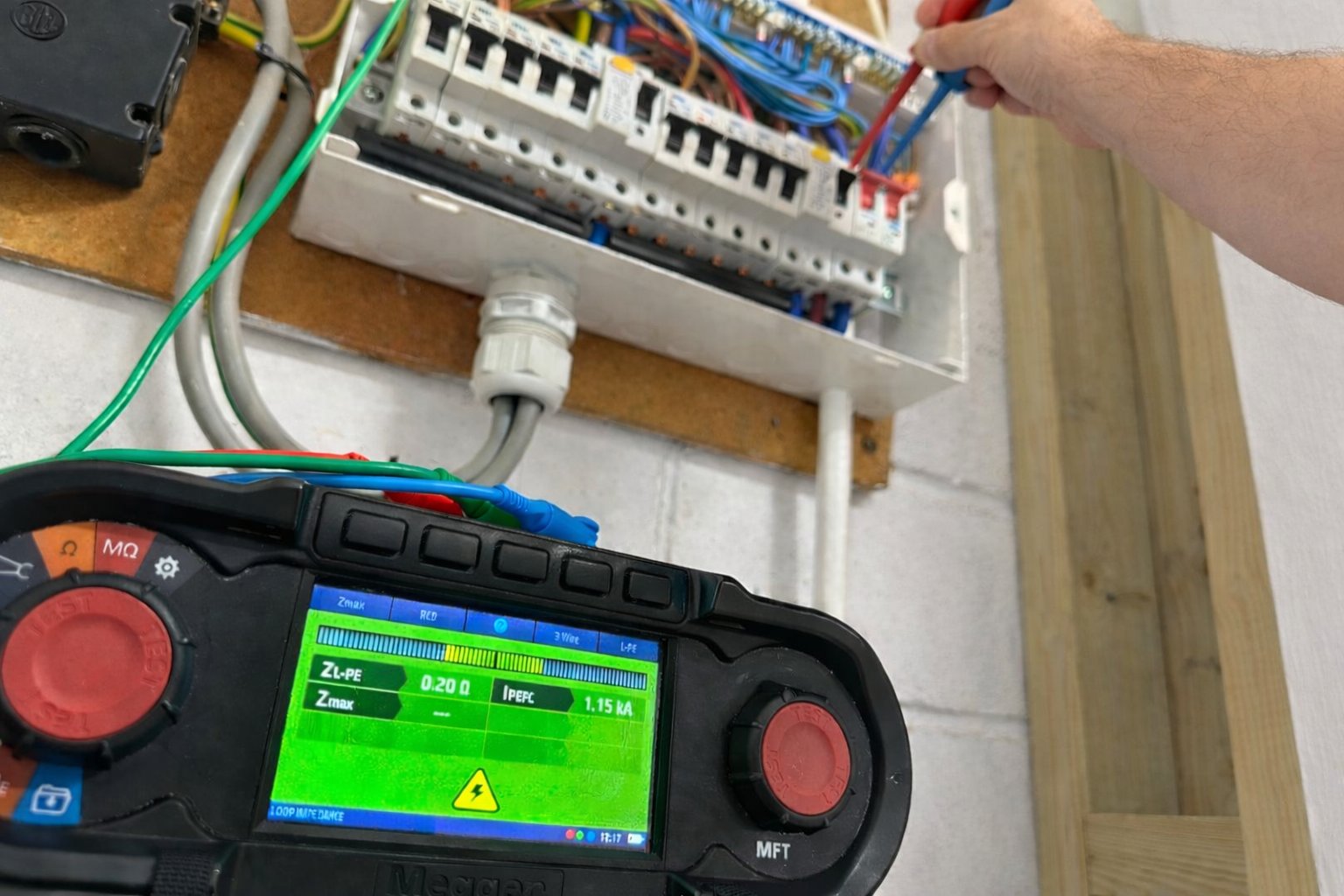
Final testing: Thermal re-check under load, earth fault loop impedance and RCD operation.
Outcome: Buzzing gone and the board running cool. A full board replacement was quoted as the longer-term option.
CALLOUT PRICING
Our callout charge is fixed and set by the time of day, so you know what attendance costs before we set off. Every callout includes a visual inspection and circuit testing — you are paying for a diagnosis, not just a visit.
| Callout | When | Fixed price |
|---|---|---|
| Basic callout | 9:30am–3pm, not guaranteed within the hour | £110 |
| Day callout | Daytime attendance | £130 |
| Early evening callout | Early evening | £180 |
| Overnight callout | Overnight | £250 |
Any parts or additional work needed after diagnosis are quoted and agreed with you before they begin. Repair and parts pricing: [INSERT REAL PRICE].
WHY POWER PROS
Board faults are diagnosis problems before they are repair problems. Twenty-five years of tracing faults is what turns a vague “it keeps tripping” into a specific defect at a specific terminal.
That matters here because a consumer unit repair has to be tested and certified to BS 7671 and current Building Regulations — not just switched back on.
You are told what is wrong and what it costs before anything is dismantled, and any work beyond the fixed callout is agreed with you first.
A replacement is a bigger, more profitable job than a repair. If yours can be repaired properly we will repair it. If it cannot, we will show you the test results that say so.
Where a part must be ordered we will normally make the board safe and restore power to the unaffected circuits meanwhile, so you are not left without electricity.
Round the clock across Bexhill-on-Sea, Hastings, Eastbourne and all of East Sussex, insured up to £2,000,000, with a 100% satisfaction guarantee.
CUSTOMER REVIEWS
“Very happy with Aaron this service the electrician came out quickly within 1 hour and fixed a fault tripping out my electrics which turned out to be a water leak getting into a socket outlet. Highly recommended electricians.”— Alan, Google review
“Fast, reliable and genuinely professional service. The emergency electrician Harry diagnosed the issue straight away, explained everything clearly, and carried out the repair safely and efficiently. Pricing was fair with no hidden surprises, and the work was left neat and tidy.”— Steve, Google review
“Fast and efficient electricians, we would use them again.”— Connor, Google review
Reviews from our Google Business Profile, rated 5.0 from 10 reviews. Read them on Google.
YOUR QUESTIONS
Many faults are repairable: loose or overheated terminations, a failed MCB or RCD, a faulty main switch. Replacement is the right answer when no compatible part exists, when the board itself is heat damaged, or when the measured fault current exceeds what the devices can safely break. Anyone who says it needs replacing before testing it is guessing.
Usually that it is doing its job: there is a live fault on that circuit and the device is refusing to reconnect to it. Sometimes the device itself has failed mechanically, which is a repair at the board. Do not keep forcing it, because repeated attempts can weld the contacts closed.
Usually not. A single circuit dropping out on its own points at something on that circuit — an appliance, damaged cable insulation or damp — and the MCB is doing the job it was designed for. A worn device letting go below its rating is the less common answer, and the two are separated by testing the circuit and the device, not by swapping the breaker and hoping.
An irregular buzz or crackle needs investigating urgently. A faint steady hum can come from an ageing device’s mechanism and may be harmless, but an irregular crackle commonly indicates arcing at a loose connection or a badly seated breaker, which is a real ignition source. You cannot tell them apart reliably by ear.
If there is smoke or flame, leave the building and call 999. Otherwise switch off the main switch only if the board is not hot, wet or smoking and you can reach it without touching a damaged part, keep people away, and call an electrician immediately. Do not remove the cover.
Sometimes, depending entirely on the manufacturer and range. Many ranges common in East Sussex housing were discontinued years ago. Where no genuine or manufacturer approved device can be sourced there is no compliant repair, and replacement is the honest recommendation. We check availability for your board rather than assume.
No. A consumer unit is certified as a complete assembly under BS EN 61439-3, with enclosure, busbar and devices tested together. Another maker’s device invalidates that certification even if it clips on, and differing busbar contact geometry can cause exactly the overheating you called us about.
Yes, a serious one. That button exists to prove the device operates. If it does not trip the RCD, the device has failed and is giving no earth leakage protection at all while looking completely normal. Testing every RCD with the button every six months is the one electrical check a householder can safely do.
Power is off for part of the visit, because nothing inside a board can be worked on until it is isolated and proved dead. A loose termination is found and remade quickly; an intermittent earth fault takes longer, and an obsolete part may mean a return visit. Tell us if you have medical equipment or freezers.
Replacing a device inside an existing board is maintenance and is not notifiable under Approved Document P in England, whereas replacing the whole consumer unit is. For a repair you should receive a Minor Electrical Installation Works Certificate recording the work and the test results.
The callout is a fixed price set by time of day: £110 for a basic callout between 9:30am and 3pm which is not guaranteed within the hour, £130 for a day callout, £180 early evening and £250 overnight. That includes a visual inspection and circuit testing. Parts and further work are quoted and agreed first.
Have the installation periodically inspected and tested rather than waiting for symptoms; an EICR checks terminations, device operation and insulation condition before they become faults. Test your RCDs every six months, avoid running high current appliances through extension leads, and get leaks near the board fixed promptly.
MORE SERVICES
AREAS WE COVER
Power Pros cover Bexhill-on-Sea, Hastings, Eastbourne and towns right across East and West Sussex, 24 hours a day. Towns shown as a link have their own page; for anywhere else on the list, call 0333 360 8583 and tell us the postcode.
East Sussex
West Sussex
SPEAK TO AN ELECTRICIAN
The consumer unit is the one part of the installation whose job is to protect everything else. When it is the part that is failing, the protection you are relying on may not be there. We diagnose the fault, tell you honestly whether it can be repaired, and agree the price before we start.
