Home › Services › Emergency Electrician
You have reached an emergency electrician. If you have lost power, your fuse box will not stay on, or something has started to smell hot, call us and we will tell you how urgent it is before we even set off. We answer 24 hours a day, every day of the year.
HAPPENING RIGHT NOW
If you recognise yourself in this list, you are in the right place. Every one of these is something we attend as an emergency.
If there is fire, smoke or an injury, ring 999 first and then call us. If your whole street is dark, the fault is likely to be on the network, so ring 105 free of charge before paying for a callout.
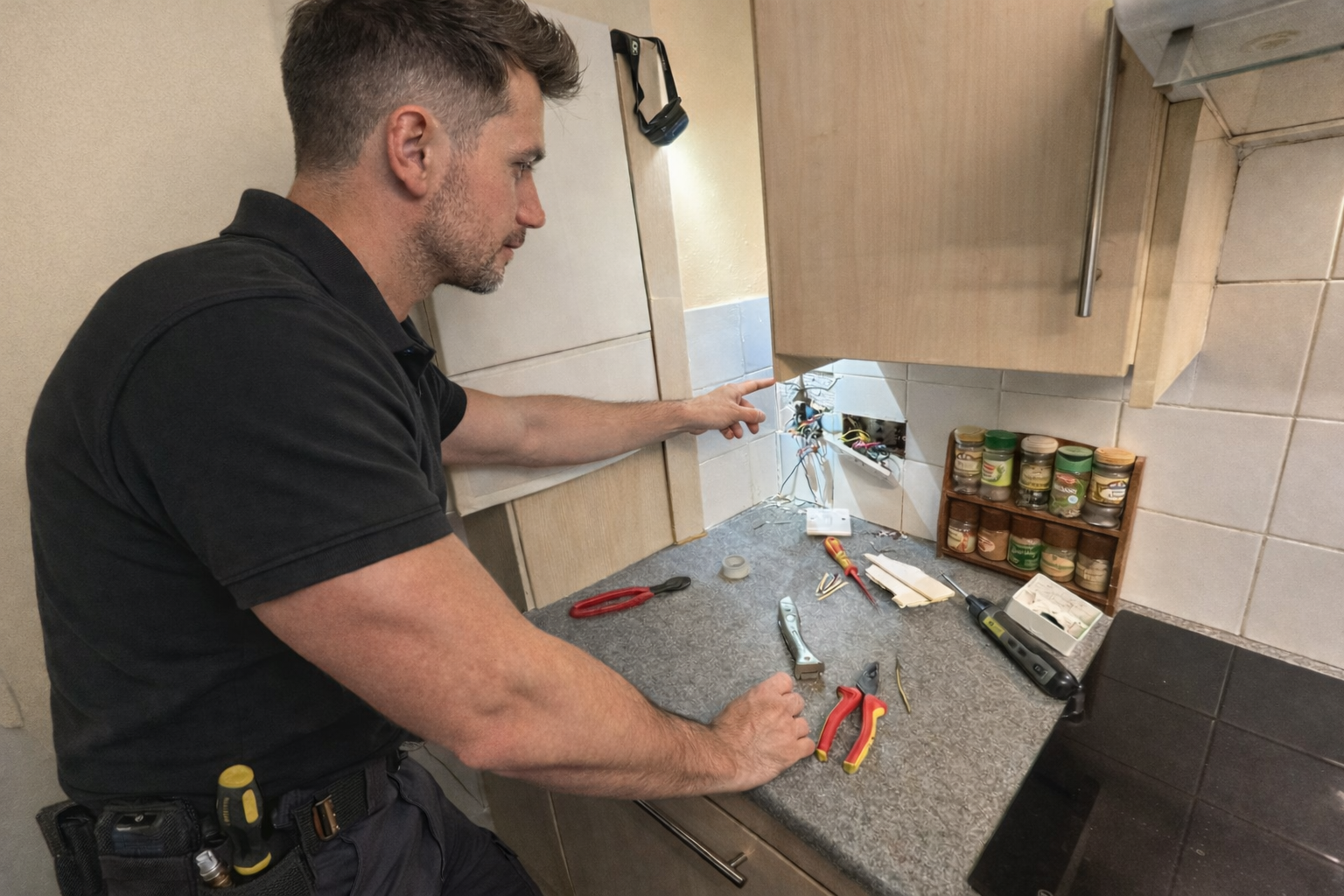
An emergency electrician is not simply an electrician who works late. The job is different from planned work: you arrive at a property where something has already gone wrong, often with no history and no drawings, and your first task is to decide whether the installation is dangerous. Only then does the diagnosis begin.
In practice a callout has three jobs, in this order. First, make it safe. Second, find the fault, which means proving where it is with test instruments rather than guessing from symptoms. Third, restore as much of the installation as can be restored safely, and tell you plainly what is left to do if anything is.
That middle step is where experience shows. Two properties can present with exactly the same complaint, an RCD that will not reset, and have completely different causes: one a perished immersion heater element, the other a nail driven through a cable behind a skirting board twenty years ago that has finally tracked to earth after a damp winter. The symptom tells you almost nothing. Testing tells you everything.
Every Power Pros callout includes a visual inspection and circuit testing as standard, and all work is tested to BS 7671 and complies with current British Standards and Building Regulations. If the fault turns out to be something more involved, such as tracing an intermittent fault across several circuits or a consumer unit that has reached the end of its life, we tell you before any additional work starts and agree the cost with you first.
FAULTS WE ATTEND
Everything dead, but the street is fine. Common causes are a main switch or RCD that has tripped and will not reset, a blown supply fuse, or a failure in the meter tails or the main earth. We establish first whether the supply is arriving at the property before touching anything inside. More on power loss and tripping.
The classic emergency. An RCD trips because it has detected current leaking to earth, and it will keep tripping until that leakage is removed. Finding it means splitting the installation circuit by circuit and measuring, not swapping parts and hoping. More on RCD tripping.
A smell of hot plastic, or a warm socket or switch plate, usually means a connection is loose and generating heat. This is the fault type that most often precedes a fire and it is always treated as urgent. More on burning smells and dangerous electrics.
A flash when a plug goes in, a crackle from a switch, or brown staining around a socket. Arcing damages contacts each time it happens, so the fault worsens with use. The accessory and the cable behind it both need inspecting. More on socket faults.
The circuit is fine until the shower, oven, kettle or heater runs. That points to an overload, a deteriorating connection that only fails when it warms, or an appliance drawing more than it should. It needs measuring while loaded to be certain.
A leak from a bathroom, a flooded garage, driven rain into an outside socket or a garden light. Water bridges live parts to earth and can leave an installation live in places it should not be. The affected circuits are isolated before anything else.
All the lights out upstairs, or lights that flicker and surge together. Flickering across several rooms can indicate a loose or failing neutral, which is a genuinely serious fault rather than a nuisance. More on lighting faults.
A tingle from a tap, a metal sink, an appliance case or a switch plate is never acceptable and often points to a broken earth or missing main protective bonding. It is treated as an immediate danger and tested straight away.
A cable cut by a drill, a socket pulled off the wall, a light fitting brought down by a leak, or storm damage to an outside supply. We make the installation safe first, then repair or replace. More on emergency electrical repairs.
WHAT CALLERS SAY
These are the phrases we hear most often. If one of them is close to what you were about to say, it is worth ringing now rather than waiting to see whether it settles down.
"Everything went off with a bang and now the big switch won't stay up."
"There's a smell like burning fish behind the fuse box and I don't know if it's dangerous."
"It only trips when the washing machine gets to the hot bit."
"The lights in the whole house dim every time the fridge kicks in."
"I got a little tingle off the kitchen tap. My wife felt it too."
Three of those descriptions carry more urgency than most people realise. A burning smell means something is already hot. A shared dimming across the whole property can indicate a poor neutral connection, which can push voltages out of tolerance and damage appliances. And any tingle from metalwork suggests the protective earth path may not be doing its job, so a fault that should trip a device in a fraction of a second might not. None of these can be confirmed without testing, but all three warrant a call rather than a wait.
COMMON CAUSES
Emergencies feel random. They rarely are. The great majority come down to a handful of mechanisms, and knowing which one you are dealing with is most of the job.
Every appliance leaks a tiny amount of current to earth, and filters in modern electronics leak by design. A 30mA RCD may trip well below its rated figure, so a few milliamps each from a dishwasher, a washing machine, an oven and a bank of chargers can add up until one more item tips it over. That is why an RCD can start tripping without anything obvious having changed.
Cable insulation degrades with heat, damp, age, vermin and physical damage. Once the insulation between a conductor and earth deteriorates, current finds a path it should not have. Damp weather often makes a long-standing fault finally show itself, which is why faults cluster after heavy rain.
A screw terminal that was never tightened, or has worked loose through thermal cycling, presents a small resistance. Current through resistance makes heat, heat makes the joint worse, and the fault accelerates. This is the mechanism behind most burning smells, discoloured sockets and heat-damaged consumer units.
Heating elements in showers, immersion heaters, washing machines, dishwashers and kettles fail by allowing current through to the earthed metal around them. These typically trip the RCD only once the element reaches temperature, which is why the fault seems to follow a programme cycle.
A ring final circuit that has been broken at one point still works, but is no longer sharing load as designed and can overheat. A neutral connection that has failed or become high-resistance produces flickering, dimming and voltage swings across the property, and is one of the faults that most justifies an out-of-hours callout.
Leaks into ceiling roses and downlights, driven rain into outdoor sockets, a nail or screw through a buried cable, or rodents in a loft. All create a direct path from a live conductor to earth, which is exactly what protective devices are built to detect.
Rewireable fuses, no RCD protection, and plastic enclosures that were never designed for today's loads. An older board may not disconnect quickly enough on a fault, and its own connections are often the ones running hot. More on fuse box and consumer unit repairs.
Extension leads feeding heaters, a kitchen full of high-current appliances on one circuit, or a garage supply asked to run far more than it was designed for. A breaker doing its job here is not a fault, it is a warning that the circuit is being asked for more than it can give.
These are the causes we see most frequently. They are not a diagnosis of your installation, which can only be confirmed by inspection and testing on site.
OUR DIAGNOSTIC PROCESS
This is where a callout is either worth the money or is not. Guesswork replaces parts until the symptom goes away. Testing proves where the fault is. With 25 years of fault-finding experience behind it, this is the sequence we follow.
FROM CALL TO FIX
STAY SAFE
There is fire, smoke or flame. You can see an exposed live conductor. Someone has received a shock and is injured, unwell or was unable to let go. In those situations leave the area, do not touch anyone still in contact with the electrics, and call the emergency services before you call an electrician.
A protective device that trips is not a nuisance, it is the installation telling you it has found something wrong. The device is the last line of defence between a fault and a fire or a shock, and defeating it removes that protection entirely.
Until testing has been done, nobody can tell you honestly what your repair will be. What we can tell you is the shape of the outcomes, because most emergency callouts end in one of these.
Repair work, parts and any follow-up remedial work are priced separately from the callout: [INSERT REAL PRICE]. Whatever the job, it is quoted and agreed with you before it begins, and all work carries our 100% satisfaction guarantee and is tested to BS 7671.
Location: Hollington, St Leonards-on-Sea
Customer's problem: Whole flat lost power at about 10:40pm and the main switch would not stay up.
Initial symptoms: Everything dead, main switch dropping the instant it was pushed up, and a faint hot smell near the airing cupboard.
Tests performed: Supply confirmed live at the cut-out, then circuits isolated one at a time and insulation resistance measured at 500 V DC on each.
Fault discovered: The immersion heater element had failed to earth, reading close to zero megohms.
Repair: Immersion circuit isolated and locked off at the board so the rest of the flat could be restored.
Final testing: Insulation resistance, polarity and RCD trip times on every circuit put back into service.
Outcome: Power back on inside the visit. Replacement element quoted separately and fitted later that week.
CALLOUT PRICING
An electrician call out at 2am costs more than one at lunchtime, and there is no reason for that to come as a surprise. Our callout charge is fixed and set by the time of day, so you know what you are committing to before we set off. The callout covers attendance, the visual inspection and the circuit testing needed to identify the fault.
| Callout type | Price | Notes |
|---|---|---|
| Basic callout, 9:30am–3pm | £110 | Our lowest rate. Not guaranteed within the hour. |
| Day callout | £130 | Standard daytime emergency response. |
| Early evening callout | £180 | Out-of-hours attendance. |
| Overnight callout | £250 | Through the night, every night of the year. |
The callout is fixed. What sits on top of it depends on what the testing finds, and honestly, that is the only variable worth talking about. The things that move it are: how long the fault takes to locate, and an intermittent fault that only appears under certain conditions takes longer than a dead short; whether parts are needed and which ones; whether the repair is at an accessible point or behind plaster, under floors or in a loft; and whether the safe answer is a repair or a replacement.
What will not change is how you find out. Anything beyond the callout is quoted and agreed with you before work starts. If we cannot complete the repair on the visit, we make the installation safe, tell you what is left and price it before you commit to anything.
Prices shown are the callout charges only. Repairs, parts and further remedial work are quoted separately and agreed in advance.
24/7 EMERGENCY LINE
Tell us what is happening and we will tell you how urgent it is. We answer 24 hours a day across Bexhill, Hastings, Eastbourne and all of East Sussex.
WHY POWER PROS
24 hours a day, 7 days a week, including weekends and bank holidays. Electrical faults do not keep office hours, and a burning smell at 1am should not have to wait until Monday.
Emergency work is diagnostic work. Our 25 years of fault-finding experience is the reason the questions on the phone are already narrowing things down, and the reason we test rather than swap parts and hope.
85% of our emergency callouts are resolved on the first visit. That matters when you have no heating, no hot water or a business that cannot open.
A fixed callout charge set by time of day, and any further work quoted and agreed before it starts. No surprises added to the bill after the fact.
Part P registered with City & Guilds qualified electricians. Work is tested to BS 7671 and complies with current British Standards and Building Regulations. [INSERT REAL QUALIFICATION]
Cover up to £2,000,000, which matters when someone is working on your installation at short notice and, in a rented or commercial property, matters to your insurer too.
Bexhill-on-Sea, Hastings, Eastbourne and all of East Sussex. We attend [INSERT REAL FIGURE] emergency callouts a year across the county, which is the real advantage of a local electrician: the housing stock and its typical faults are already familiar ground.
A 100% satisfaction guarantee on all our services, and testing to prove the repair rather than just an assurance that it should be fine now.
CUSTOMER REVIEWS
“I had a sudden electrical fault late in the evening and Power Pros came to the rescue. From the first call they were professional, calm and very reassuring. The electrician arrived quickly, clearly explained what the issue was, and got everything safely sorted without any hassle.”— Jane Baker, Google review
“Power Pros provided an excellent service from start to finish. They responded quickly, arrived when they said they would, and got straight to diagnosing the problem. Everything was explained clearly, with no pressure or hidden costs, which was really reassuring in an emergency situation.”— Tina, Google review
“All ok the emergency electrician turned up in the stated time, overall happy with the service. 5 stars.”— Richard, Google review
Reviews from our Google Business Profile, rated 5.0 from 10 reviews. Read them on Google.
YOUR QUESTIONS ANSWERED
Anything involving heat, smoke, burning smells, sparking, arcing noises, scorch marks or an electric shock is an emergency and should be dealt with straight away. So is water reaching electrical equipment, and any exposed or damaged live cable. Loss of power is an emergency when it leaves you without heating, hot water, refrigeration, lighting, a stairlift, a medical device or the ability to trade. A protective device that trips once and then behaves is usually not urgent, but a device that will not stay on is telling you a fault is present and that fault needs finding.
Yes. Power Pros operates 24 hours a day, 7 days a week, including weekends and bank holidays. Call 0333 360 8583 at any hour. Callout pricing changes with the time of day, which is why the price table on this page shows a day, early evening and overnight rate.
Ring 0333 360 8583 and you will speak to someone whatever the hour. We ask what you can see, hear and smell, work out how urgent the fault is, and tell you the callout charge for that time of day before anyone sets off. We work to a one-hour response on emergency callouts across Bexhill-on-Sea, Hastings, Eastbourne and all of East Sussex, with the exception of the discounted 9:30am to 3pm slot, which is not guaranteed within the hour. If your neighbours have lost their power too, the fault is on the network rather than in your property, and we will point you to 105 free of charge instead of charging you for a callout.
Probably not. If the whole street is dark, the fault is almost certainly on the distribution network rather than inside your property. Call 105, which is the free national number that connects you to your local network operator, and they will deal with it. If only your property is affected while neighbours have power, the fault is on your side and an electrician is the right call.
Unplug everything on the affected circuits, particularly anything that heats water or lives outdoors, such as a kettle, washing machine, dishwasher, immersion heater, shower, outside lights or a garden socket. Switch off at the wall as well as unplugging. Then try the RCD once. If it holds, one of those appliances is very likely the source of the leakage and testing will confirm which. If it still will not hold, leave it off and call us rather than repeatedly forcing it.
Yes. A hot plastic or fishy smell around a consumer unit, socket or switch commonly indicates that a connection is overheating, and overheating connections are how electrical fires start. Switch the affected circuit off if you can reach the breaker safely, do not open anything, and call us. If you can see smoke or flame, leave the building and call 999 first.
Our callout charge is fixed by the time of day: £110 for a basic callout between 9:30am and 3pm which is not guaranteed within the hour, £130 for a day callout, £180 for an early evening callout and £250 for an overnight callout. That covers attendance, a visual inspection and circuit testing. If further work is needed beyond that, we quote it and agree it with you before we start, so nothing is added without your say so.
Usually. Power Pros resolves 85% of emergency callouts on the first visit. The cases that need a second visit are normally those needing a part we do not carry, a full consumer unit replacement, or work that cannot be completed safely at night, such as tracing a buried cable through several rooms. Where a full repair has to wait, we make the installation safe before we leave and tell you exactly what remains.
No. One reset to see whether it was a one off is reasonable. Repeatedly forcing a device back on is not. The breaker is doing its job by disconnecting a circuit it has judged to be faulty, and every reset puts current back through whatever is wrong, which can turn a small fault into heat damage or a fire. If it will not stay on, leave it off and wait.
That is a common outcome and it is still a result. Faulty heating elements in washing machines, dishwashers, kettles, immersion heaters and showers are among the most frequent causes of an RCD that will not reset. We identify the item, disconnect or unplug it so the rest of your installation can be restored, and tell you what needs replacing or repairing. We do not repair white goods themselves.
Access to the consumer unit and to the meter, and someone on site who can authorise the work. It also helps enormously if you can tell us what was happening at the moment the fault started, because that single detail often points straight at the circuit. If you have any previous certificates or an EICR, have them to hand, though we can work without them.
Yes. We attend domestic, landlord and commercial emergencies across Bexhill, Hastings, Eastbourne and all of East Sussex. For rented property we can attend with the tenant present and report back to the landlord or agent, and we can advise where an emergency fault points to a wider problem that an EICR would pick up.
Yes. All work is tested to BS 7671 and complies with current British Standards and Building Regulations, and we are Part P registered. Certification is issued to suit the work done, which for a repair to an existing circuit is normally a Minor Electrical Installation Works Certificate, and for a new or replaced consumer unit is an Electrical Installation Certificate.
Most repeat emergencies come from three things: connections that were never tightened properly, an installation that has quietly aged past its useful life, and moisture reaching outdoor or garage circuits. A periodic inspection, recorded on an EICR, finds all three before they become a 2am phone call. If your consumer unit still has rewireable fuses or no RCD protection, that is the single most worthwhile upgrade you can make.
MORE HELP
If you already know roughly what you are dealing with, these pages go into more detail.
AREAS WE COVER
Power Pros cover Bexhill-on-Sea, Hastings, Eastbourne and towns right across East and West Sussex, 24 hours a day. Towns shown as a link have their own page; for anywhere else on the list, call 0333 360 8583 and tell us the postcode.
East Sussex
West Sussex
CALL ANY HOUR
Bexhill-on-Sea, Hastings, Eastbourne and all of East Sussex. Part P registered, fully insured to £2,000,000, fixed callout prices and a 100% satisfaction guarantee. Tell us what is happening and we will tell you what to do next.
