Home › Services › Power Loss & Electrical Tripping
Lost all your power, or got a breaker that won't stay on? Sometimes it's the electricity network, and no electrician can help. Sometimes it's a fault in your own wiring that has to be found properly. We'll tell you honestly which one you're looking at — and if it's on your side of the meter, we'll test it, find it and fix it.
SPOT YOUR PROBLEM
Find yours on the list. Has the power gone off completely, or does one circuit drop out once a day? Either way, the pattern is telling us something.
Ring 0333 360 8583 and describe what you can see. That conversation alone often narrows it down.
SUPPLY OR WIRING
The first thing to establish is whose side of the meter the fault sits on. The supply side — the street cables, the service cable, the sealed cut-out holding the network's main fuse, and the meter — belongs to the distribution network operator (UK Power Networks here) and your supplier, and its seals must not be touched without their authorisation. The installation side starts at the meter tails: the consumer unit, or fuse box, and every circuit in the building. That part is yours, and it's what we work on.
Neighbours are off too, or the street lights are out. Your main switch is up, every breaker looks normal, and nothing works. The meter display is blank and stays blank. 105 is the free national powercut number from any phone. If someone there depends on electricity for medical equipment, say so — operators keep a Priority Services Register.
Prepayment credit has run out or a top-up hasn't landed. The meter shows an error code or a padlock symbol. Or only the off-peak circuit is dead — storage heaters or the immersion cold while everything else works — which can be the meter's switching rather than your wiring.
The neighbours have power and you don't. A breaker or RCD has visibly tripped, sitting lower than the ones beside it. The main switch has gone off on its own. Part of the property works and part doesn't. It goes off when one appliance runs, when it rains, or the moment you reset it.
Being straight with you: if you ring and describe a whole street in darkness, we'll tell you to call 105 rather than send anyone out. If the network then attends, makes it safe and says the fault is inside the property, that's the moment to call us.
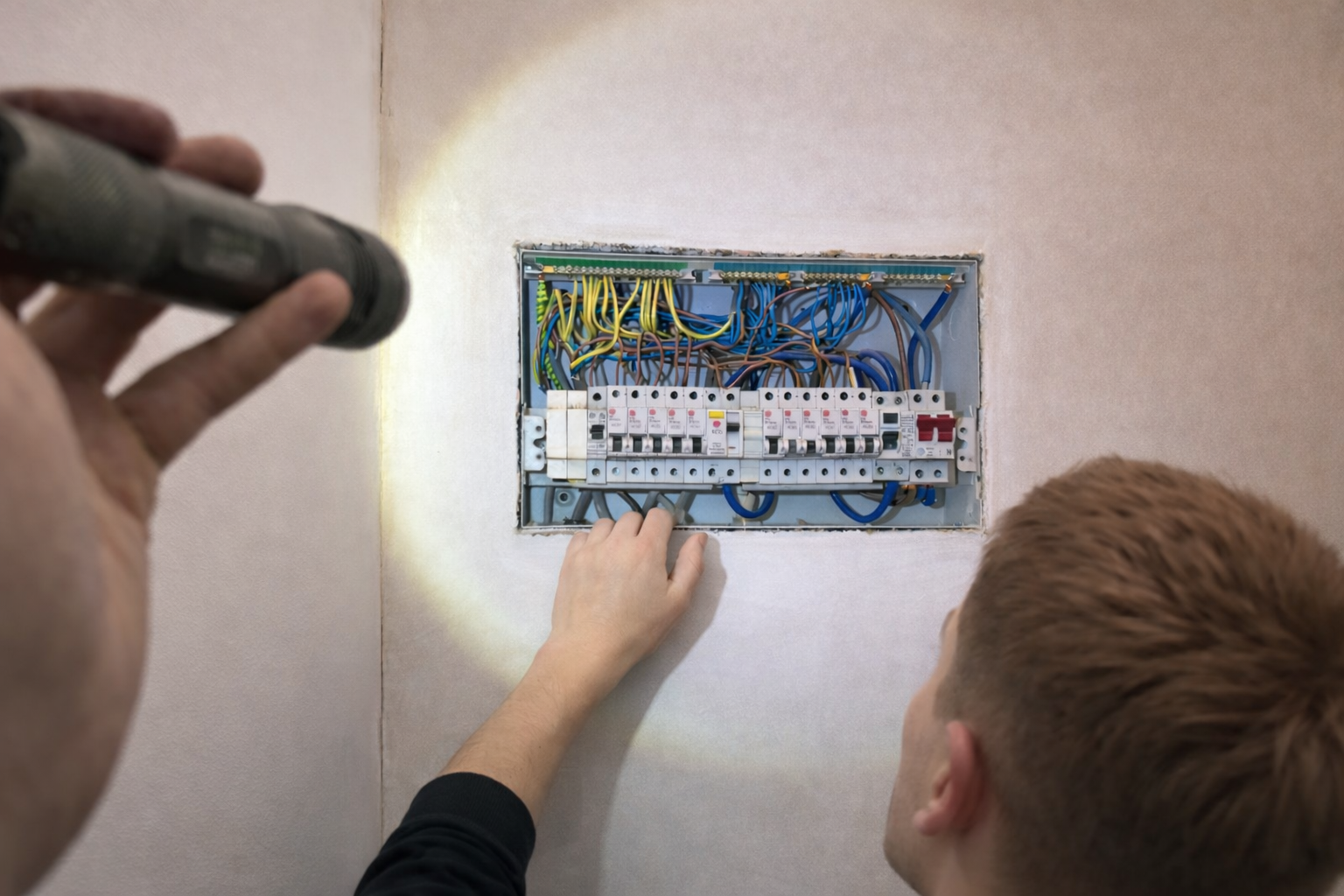
Restoring power is the easy part — anyone can push a switch back up. The work is finding out what made it operate, so it doesn't happen again and whatever caused it isn't quietly overheating a cable inside a wall. A trip is information; testing turns it into a location.
The main switch isolates everything. An MCB protects one circuit against overload and short circuit, so if one MCB keeps tripping, one circuit is dead and the rest of the board is unaffected. An RCD watches for current leaking to earth and commonly covers half the board — which is why "half my house has no power" is such a common phrase. An RCBO does both for one circuit. Tell us which is down and what still works and we start ahead — looking at the front of the board only, never opening it. If it's an RCD that won't stay on, see why an RCD trips and how earth leakage is traced.
FAULTS WE FIX
Supply reaching the meter but nothing working past it: usually a failed main switch, a loose or overheated meter tail, a failed main RCD, or a fault holding the main device open.
Partial power loss takes a few forms: one RCD off and half the circuits dead, one MCB off and one circuit dead, or a garage or annexe on a sub-main that has lost supply while the house is fine.
A device that goes straight back off means a live, present fault, not a historic one. It needs finding before power is restored, not after.
Fine until the shower runs or the dryer heats. Repeatable triggers are the quickest faults to pin down, because we can provoke them on demand while measuring.
The hardest category, and where testing earns its keep. Damp-related, seasonal and timer-driven faults all live here.
Supply is back on the street but the property isn't right. Switching transients on restoration finish off components already near failure, and water tracking into an external socket or a loft is a classic storm-week fault.
COMMON SYMPTOMS
Usually one RCD on a split-load consumer unit. Circuits are shared between two RCDs, so a single fault takes out one half of the property. Testing identifies which circuit it's on.
"Looks fine" is normal for most electrical faults. A nail through a cable behind plaster, a rodent-chewed loft cable, a degraded immersion element or a wet external socket all look like nothing from inside the room.
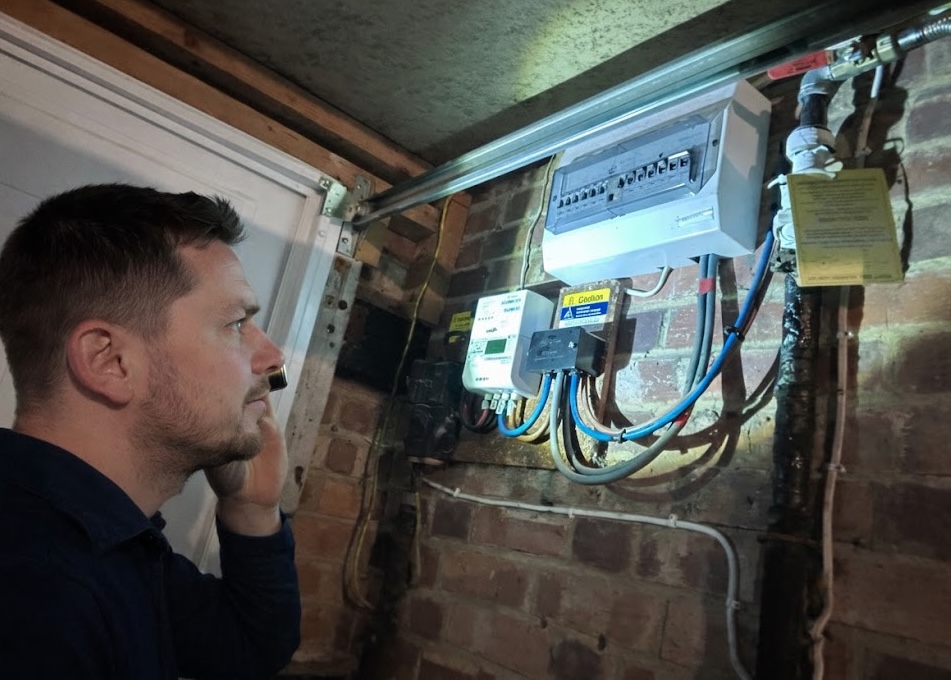
Now it's likely yours: the network's main fuse serving your property alone, or a main switch, meter tail or RCD in your installation. Meter display dead, ring 105. Meter alive and board dead, ring us.
Water is the usual answer: an outside socket or light, a shed or garage circuit, or a cable in a damp wall. Faults like this often only show themselves in wet weather, which is why they're traced by testing rather than by looking.
24/7 EMERGENCY LINE
Has the electricity gone off everywhere, or only in part of the property? Tell us what's off and what still works. We'll say straight away whether this is a job for 105, for your supplier, or for us — and what the callout costs before anyone sets off.
WHY IT TRIPS
Too much current, for too long, on a circuit not rated for it. An MCB contains a bimetallic strip that bends as it heats, so an overload trip is deliberately slow — minutes, not milliseconds. The answer is redistributing load or adding a circuit, never a bigger breaker.
Line and neutral making direct contact: the current is enormous and the MCB's magnetic element operates instantly, often with an audible crack. Usually a screw or nail through a cable from flooring, shelving or a TV bracket, a cable crushed under a floorboard or loft insulation, rodent damage, or water bridging terminals.
Insulation degrades with age, heat, damp and damage, and current finds a path to earth it shouldn't have. Depending how good that path is, it may operate the MCB, the RCD, or both — the mechanism behind most "it trips when it rains" faults. How leakage is measured sits on our RCD tripping page.
Terminals work loose through thermal cycling. A loose connection heats, oxidises, heats more, and eventually browns the terminal. Loose neutrals are worst: flickering, partial loss and unstable voltage before anything trips. Anything scorched needs urgent attention to dangerous electrics.
Immersion heaters, showers, washing machines, dryers and ovens are the repeat offenders. Elements break down to earth as they age, often only once hot — which is why an appliance can test perfectly cold and trip the board ten minutes into a cycle.
MCBs and RCDs are mechanical and they wear. One that has operated hundreds of times can trip below its rating or refuse to reset. A genuine finding — but the conclusion after testing, never the assumption before it. Replacement is covered on fuse box repairs.
HOW WE DIAGNOSE
Fault finding is a sequence, not a hunch. This is roughly how one of these calls runs.
STEP BY STEP
SAFETY FIRST
Smoke or fire: get everyone out, call 999, don't go back in. If anyone has had an electric shock, call 999 even if they seem fine — a shock can affect the heart and needs checking. Ring us once everyone is safe.
Any burning smell, heat or water ingress: leave that circuit — or the whole installation if you can't tell which — switched off until it's been inspected. A few hours without power is an inconvenience. The alternative isn't.
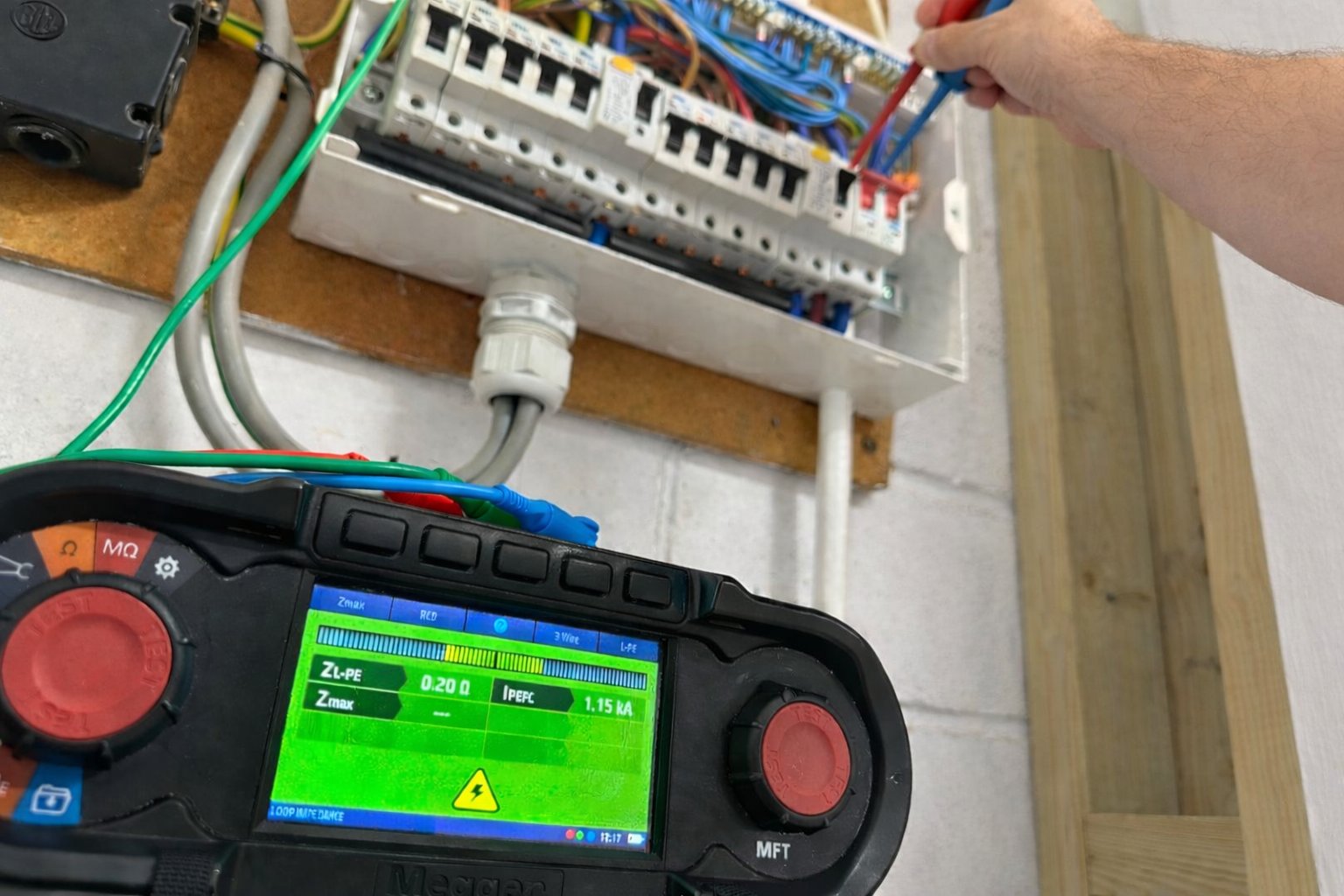
What gets done depends entirely on what the testing shows. The common outcomes:
Nobody can honestly tell you which of these you need over the phone. The answer comes from test results, you'll see them, and anything beyond the callout is quoted and agreed first.
EXAMPLE JOB
Location: Battle
Customer's problem: Half the house went dead during a storm and stayed off.
Initial symptoms: Downstairs fine, upstairs sockets and lighting dead, and nothing tripped at the board.
Tests performed: Voltage checks at the board, continuity along the affected circuit, then a visual inspection of the loft.
Fault discovered: Rodent damage in the loft had severed a neutral conductor, which leaves a circuit dead without tripping anything.
Repair: Damaged section cut out and replaced, jointed in an accessible enclosure.
Final testing: Continuity, polarity, insulation resistance and earth fault loop impedance on the repaired circuit.
Outcome: Power restored on the visit, with advice on sealing the loft entry the rodents had been using.
An illustrative example of a typical call-out of this kind.
CALLOUT PRICING
The callout charge is fixed and set by the time of day. You'll be told which applies before we set off, so there's no surprise at the door.
| Callout | When | Price |
|---|---|---|
| Basic callout | 9:30am – 3pm, not guaranteed within the hour | £110 |
| Day callout | Daytime attendance | £130 |
| Early evening callout | Early evening | £180 |
| Overnight callout | Overnight | £250 |
Any additional work is quoted and agreed with you before it begins.
We don't publish repair prices, because an unknown fault can't be priced honestly before it's been seen. Every repair is quoted on site and agreed first.
FIXED PRICES
Fixed callout charges, 24 hours a day, across Bexhill, Hastings, Eastbourne and all of East Sussex.
WHY POWER PROS
The triage above is how we work on the phone too. If it's a network power cut or a prepayment issue, we'll point you at 105 or your supplier rather than send an electrician you don't need.
This is diagnostic work first and repair work second. Twenty-five years of finding faults is what shortens the search — and we resolve 85% of emergency callouts on the first visit.
"It's probably the breaker" is a guess, and guesses cost you twice. Every callout includes a visual inspection and circuit testing, and the work is tested to BS 7671.
City & Guilds qualified, Part P registered electricians, insured to £2,000,000, with a 100% satisfaction guarantee on all services.
Power doesn't fail at convenient times. 24/7, 1 hour response, fixed callout price known before we set off — across Bexhill-on-Sea, Hastings, Eastbourne and all of East Sussex.
CUSTOMER REVIEWS
“Very happy with Aaron this service the electrician came out quickly within 1 hour and fixed a fault tripping out my electrics which turned out to be a water leak getting into a socket outlet. Highly recommended electricians.”— Alan, Google review
“Fast, reliable and genuinely professional service. The emergency electrician Harry diagnosed the issue straight away, explained everything clearly, and carried out the repair safely and efficiently. Pricing was fair with no hidden surprises, and the work was left neat and tidy.”— Steve, Google review
“All ok the emergency electrician turned up in the stated time, overall happy with the service. 5 stars.”— Richard, Google review
Reviews from our Google Business Profile, rated 5.0 from 10 reviews. Read them on Google.
YOUR QUESTIONS
A protective device is detecting an overload, a short circuit, or current leaking to earth through damaged insulation, water or a failing appliance. Only testing confirms which. Note whether it trips instantly or after a delay, and what was running — the pattern narrows it a long way.
Look outside. Neighbours and street lights out means a power cut — call 105. If everyone else has power but your meter display is dead, 105 is still the right first call: it may be a network fault on your property alone. Meter alive but the consumer unit dead means it's your installation.
Yes, free from any landline or mobile. It reaches the distribution network operator who owns the cables — UK Power Networks here — not the supplier you pay. They handle power cuts, damaged network equipment and the main fuse in the cut-out. Meter faults and prepayment credit go to your supplier.
Not one on the network's side of the meter. There is no such thing as a power cut electrician who can restore supply from the street — that work belongs to the distribution network operator, and 105 reaches them free from any phone. Where we come in is afterwards: if the network confirms the supply is present and the property is still dead, or the neighbours have power and you don't, the fault is inside your installation and we can test it.
No. One or two attempts with appliances unplugged is reasonable. Beyond that you're forcing power into a live fault, and every reset heats whatever is at fault a little more. A contained fault can become a fire. If it won't hold, leave it off and call.
Timing separates two causes. Instantly means a fault in that appliance or its circuit, usually an element breaking down to earth. Several minutes in means overload — the breaker's thermal element heating up because the circuit is carrying more current than it's rated for.
Something on a timer is switching itself on. Immersion heaters, storage heater charging periods, freezer defrost cycles, heating controls and outside lights on a photocell all run to a schedule. The time it happens is a strong clue, so please mention it.
We work 24 hours a day, 7 days a week, and the overnight callout is £250. We resolve 85% of emergency callouts on the first visit. Sometimes one faulty circuit is left safely isolated so the rest of the property works, with the repair booked in — you'll be told which before any work starts.
Yes — the test results and a certificate appropriate to the work carried out. Everything is tested to BS 7671 and complies with current British Standards and Building Regulations. Keep it: it matters for insurance, for letting, and for whoever works on the installation next.
RELATED HELP
If your situation is a little different, one of these will fit better.
AREAS WE COVER
Power Pros cover Bexhill-on-Sea, Hastings, Eastbourne and towns right across East and West Sussex, 24 hours a day. Towns shown as a link have their own page; for anywhere else on the list, call 0333 360 8583 and tell us the postcode.
East Sussex
West Sussex
CALL ANY HOUR
Lost power, or electrics that keep tripping? We'll help you work out whether it's the network, your meter or your wiring — and if it's your wiring, we'll test it, find it and fix it.
