Home › Services › Consumer Unit / Fuse Box Replacement
Old fuse box with rewireable fuses, no RCD, no spare ways, or codes against it on an EICR? A board change is planned work, not a panic. We test the existing circuits first, fit a board that meets BS 7671, then certify and notify it. If yours is hot, buzzing or smells of burning, ring us now instead.
SPOT THE PROBLEM
Repair or replacement? Call 0333 360 8583 and describe what you are looking at. If a repair will do, we will say so — see fuse box and consumer unit repairs.
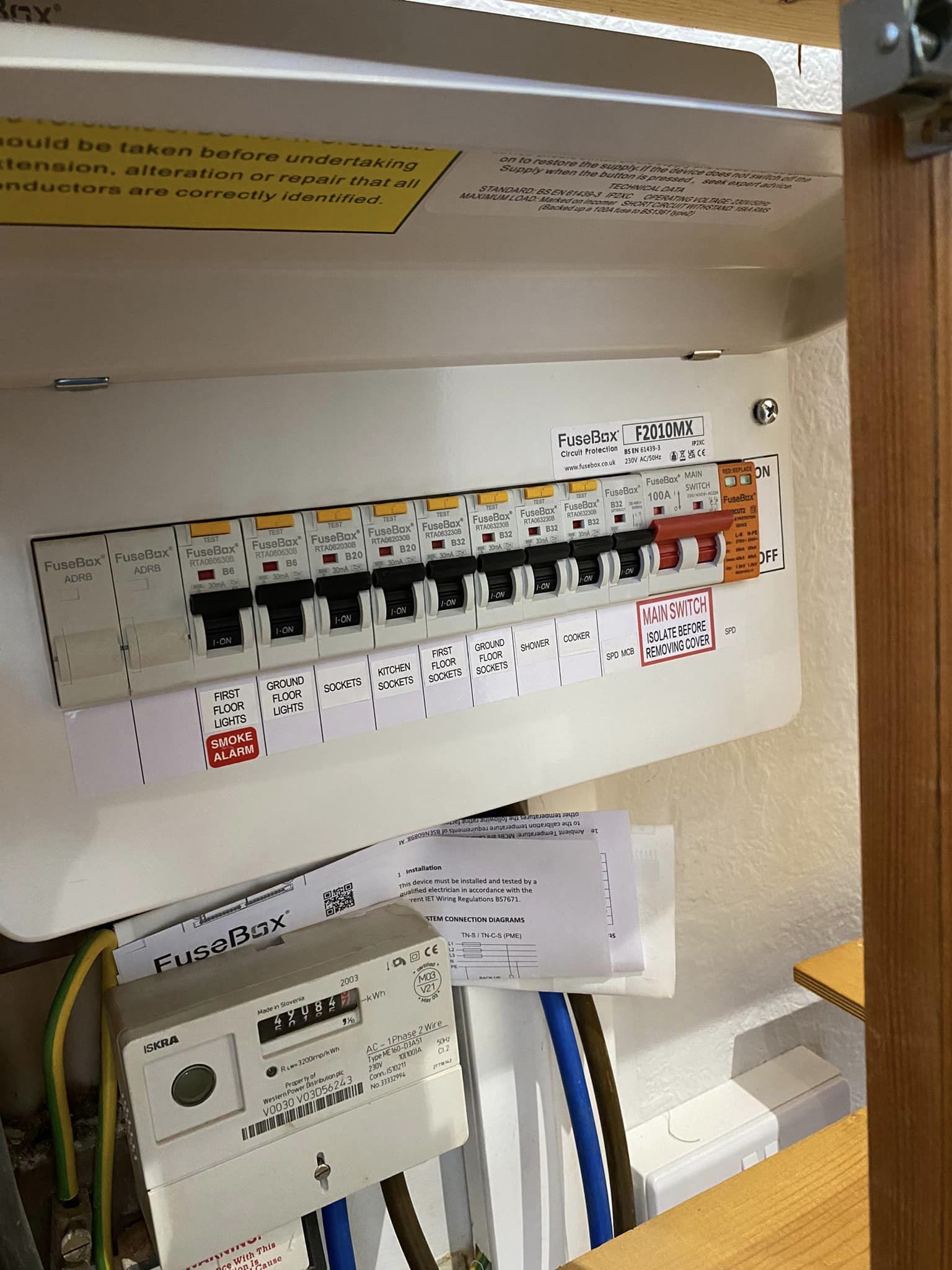
Your consumer unit — the fuse box, fuse board or trip switch box — does four jobs. It isolates the installation with a main switch; it protects the cables from overload and short circuit using fuses, MCBs or RCBOs; it protects people from shock using RCDs or RCBOs that detect current leaking to earth; and it is where the earthing and main protective bonding terminate. A board is due for replacement when it can no longer do one of those four things.
Replacement means removing the whole enclosure and everything in it, then landing every circuit on the correct protective device, renewing tails and bonding where they fall short, and certifying the result. That is a different job from swapping a failed MCB or RCD inside a board that is otherwise sound, which is a repair, and often the more proportionate answer.
BOARDS WE REPLACE
Carriers holding a strand of fuse wire. They protect against gross overload, slowly, but cannot detect earth leakage at all — and are very often rewired with the wrong gauge, so the fuse no longer protects the cable it was chosen for.
An RCD compares the current flowing out on the line conductor with the current returning on the neutral. If they stop balancing — because some is escaping to earth through damaged insulation, a nail through a cable, or a person — it disconnects in milliseconds.
An EV charge point, heat pump, shower or garden office each need their own protected way. If the board is full, or no compatible device is made for it, the board has to change.
Scorching at a terminal, a discoloured busbar, one MCB warm when the rest are cold, or a board that hums under load. Heat causes oxidation, oxidation raises resistance, higher resistance makes more heat. It only gets worse.
A consumer unit is type-tested as a complete assembly, so another maker's MCB fitted into it means the assembly is no longer the one verified. Where the range is discontinued, replacement is often the only compliant route.
No RCD protection for sockets or buried cables, inadequate main bonding, an enclosure in poor condition. Coding is the inspector's judgement, but one properly divided new board commonly clears a cluster at once.
BEFORE YOU DECIDE
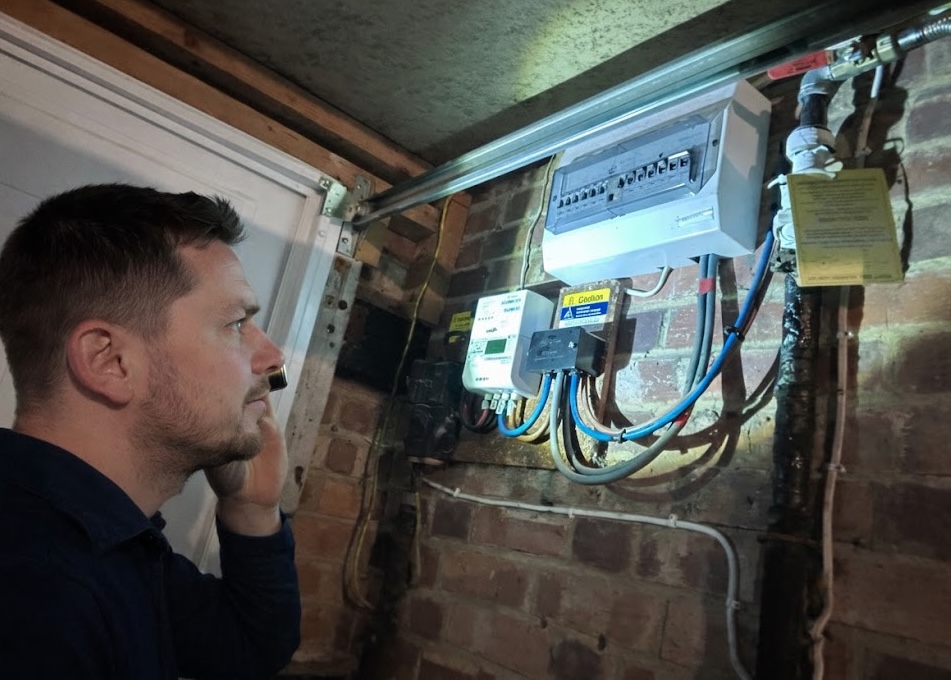
We will tell you honestly whether it is a repair or a replacement, and what the circuits behind it are like.
KNOW THE SIGNS
Then there is almost certainly no RCD. It does not make the installation dangerous today, but nothing in that board is watching for current leaking to earth.
Repeated failure of the same fuse is not a fuse problem: it is either a genuine overload or a fault on that circuit. Fitting heavier wire to stop it blowing removes the protection from the cable, and is one of the more dangerous things people do to their own homes.
A device that will not stay in is holding a fault out, not wearing out. Leave it off rather than trying again, switch off and unplug whatever is on that circuit, and call us. Where it ends — a failed device, a fault on the circuit, or a board that has to change — is decided by testing, not by looking at the front of the board.
Urgent, not a planned upgrade — overheating electrical plastics give off a distinctive acrid or fish-like smell. Read the safety advice below and our page on burning smells and dangerous electrics, then call. If instead an RCD will not stay on, or power is off in part of the property, trace that first — see RCD tripping and power loss and tripping.
The standard moved, not the board. A board fitted in 1975 complied in 1975. It was never designed to give additional protection against electric shock, because that requirement did not exist in the same form. Nothing has gone wrong with it; what we ask of it changed.
Thermal cycling at terminations. Each time a circuit is loaded and unloaded, the conductor expands and contracts slightly in its terminal. Over decades, especially on showers, cookers and immersion heaters, that works the connection loose. It is the mechanism behind most consumer unit heat damage.
Damp, salt and undocumented alterations. Boards in under-stairs cupboards, garages and seafront porches take moisture, salt-laden air and knocks, and corrosion follows. Add circuits fitted by successive occupants with no records and the board no longer describes the installation.
HOW WE TEST
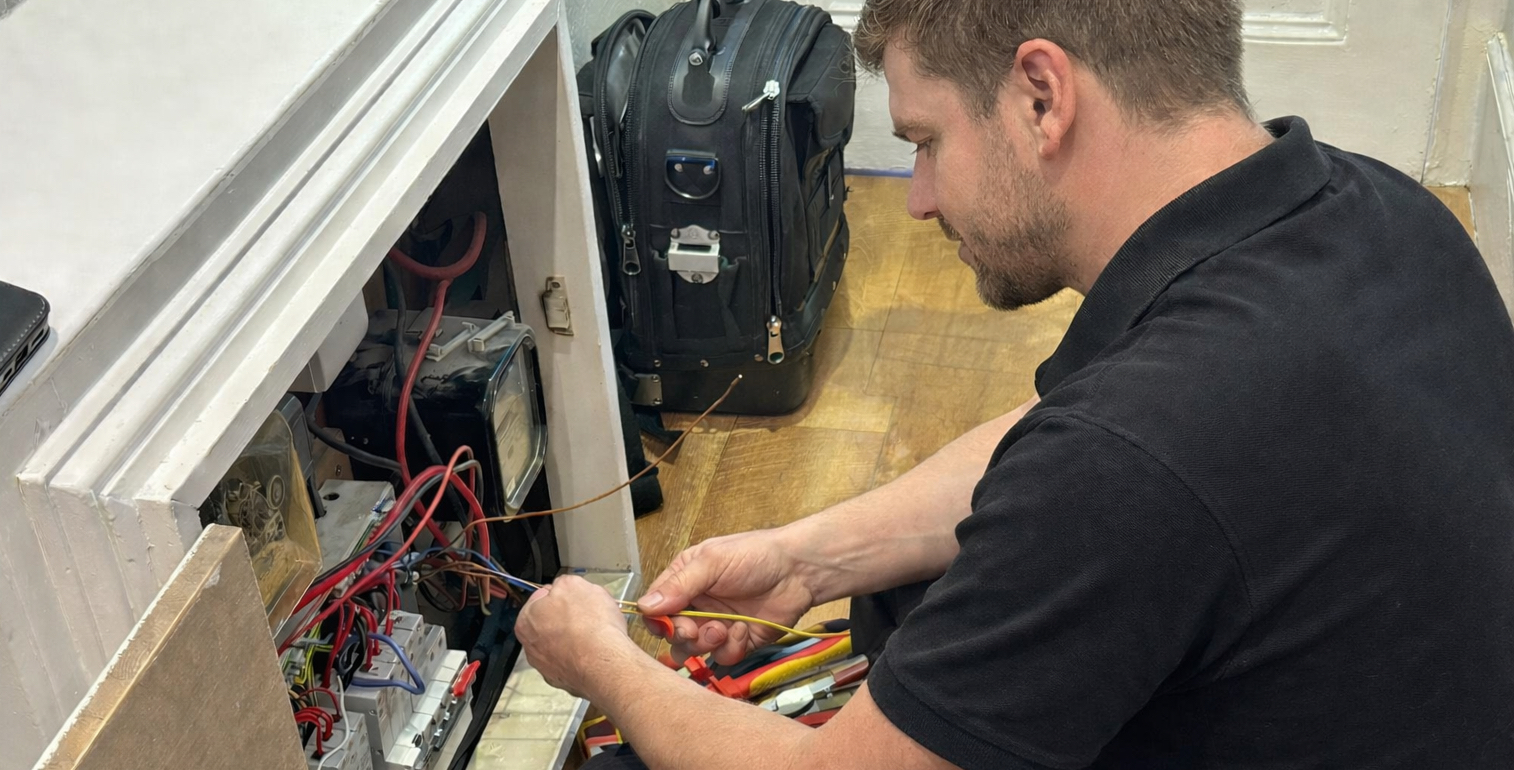
The honest answer to "should I replace my fuse box?" almost never comes from looking at the fuse box. It comes from testing what is connected to it. Every Power Pros visit includes a visual inspection and circuit testing.
Worth knowing before you commit: an old board tolerates conditions a new one will not, so pre-existing faults sometimes surface during an upgrade. Damp insulation or a borrowed neutral can sit behind a rewireable fuse for years, then trip a new RCBO immediately. Testing first finds most of them; no honest electrician will promise it finds every one. See electrical fault finding.
WHAT TO EXPECT
SAFETY FIRST
A burning or fishy smell at the board; scorching, smoke or melted plastic; crackling or arcing; the enclosure or tails hot to the touch; water running onto the board; a shock or tingle from an appliance or tap; or a breaker that will not reset. If there is fire, smoke, or anyone has had a shock injury, call 999 first.
Where there is heat damage, water ingress or arcing, leave the main switch off until an electrician has inspected the board. Tell us when you call if anyone depends on mains-powered medical equipment.
YOUR OPTIONS
The right specification depends on the survey and the test results, so treat these as the routes a job typically takes rather than a menu.
Two RCDs, each protecting a bank of circuits, with MCBs on each way. The cheaper compliant option, and fine when circuits are divided sensibly — but one fault still takes out everything on that RCD.
Every circuit gets its own device combining overload, short-circuit and residual current protection, so a fault on the garden lights takes out the garden lights and nothing else. Dearer in devices, and usually our suggestion for landlords and home workers.
An SPD clamps transient overvoltages that degrade electronics, and regulations expect it to be considered on a board change. AFDDs detect the signature of arcing from a damaged flex or loose terminal — too small to trip an MCB, capable of starting a fire.
Meter tail renewal, main earthing conductor upgrade, bonding to gas and water, an earth electrode where the installation is TT, a separate isolator, remedial work on circuits that failed pre-testing, or a new circuit for a shower or EV charger.
CASE STUDY
Location: Peacehaven
Customer's problem: A rewireable fuse box with no RCD protection, flagged during a house sale.
Initial symptoms: Old-style board with rewireable fuses, no RCD anywhere, and main bonding to water only.
Tests performed: Full pre-works inspection and testing — insulation resistance circuit by circuit, earthing arrangement confirmed and bonding conductor sizes checked.
Fault discovered: One lighting circuit with insulation resistance below the acceptable value, and main protective bonding that was undersized.
Repair: New 18th Edition board fitted with RCBOs throughout, bonding upgraded to 10 mm², and the poor lighting circuit repaired before the board was energised.
Final testing: Full schedule of test results, RCD and RCBO trip times, and loop impedance recorded at every point.
Outcome: Board replaced within the day, Electrical Installation Certificate issued and the work notified under Part P.
Replace with a genuine job from your own records before publishing, ideally with original before-and-after photographs.
CALLOUT PRICING
Our callout charge is fixed by the time of day, so you know that figure before we set off. Anything beyond it — including the board change itself — is quoted and agreed before work begins.
| Callout | When it applies | Fixed price |
|---|---|---|
| Basic callout | 9:30am – 3pm, not guaranteed within the hour | £110 |
| Day callout | Daytime attendance | £130 |
| Early evening callout | Early evening attendance | £180 |
| Overnight callout | Overnight attendance | £250 |
Price for the consumer unit replacement itself: [INSERT REAL PRICE]. Be wary of anyone who quotes a board change over the phone without asking what is behind the board.
GET A QUOTE
Fixed callout charge, a proper inspection and circuit test, and any further work agreed before it starts.
WHY POWER PROS
A board change is notifiable under Building Regulations. As Part P registered electricians we self-certify and notify, so you get the paperwork your solicitor, letting agent or insurer will eventually ask for.
Every callout includes a visual inspection and circuit testing, and all work is tested to BS 7671 — the difference between a quotation you can rely on and a number that changes on the day. If a single device has failed and a repair will do, we say so.
Board changes go wrong when nobody looks at the circuits first. Twenty-five years of fault finding is what tells us where to look for the borrowed neutral and the damp lighting circuit before they trip your new board.
City & Guilds qualified electricians, insured up to £2,000,000, a 100% satisfaction guarantee, and cover 24 hours a day across Bexhill, Hastings, Eastbourne and East Sussex.
CUSTOMER REVIEWS
“Fast, reliable and genuinely professional service. The emergency electrician Harry diagnosed the issue straight away, explained everything clearly, and carried out the repair safely and efficiently. Pricing was fair with no hidden surprises, and the work was left neat and tidy.”— Steve, Google review
“Power Pros provided an excellent service from start to finish. They responded quickly, arrived when they said they would, and got straight to diagnosing the problem. Everything was explained clearly, with no pressure or hidden costs, which was really reassuring in an emergency situation.”— Tina, Google review
“All ok the emergency electrician turned up in the stated time, overall happy with the service. 5 stars.”— Richard, Google review
Reviews from our Google Business Profile, rated 5.0 from 10 reviews. Read them on Google.
YOUR QUESTIONS
Not automatically, because the regulations are not retrospective. The question is whether it can still do its job. No RCD, worn rewireable fuses, heat damage, or no room for the circuits you need are the usual reasons we recommend replacement.
Not on its own. A device that trips is doing what it was designed to do, and the fault usually lies on one of the circuits rather than inside the board. Testing is what separates the two: a single failed device or one faulty circuit is a repair, and we will say so. Replacement becomes the answer when one trip takes the whole property off because the circuits are not divided, when there is no RCD in the board at all, or when the range is too old for a matching device to be sourced.
No, and be wary of anyone who says it is. The non-combustible enclosure requirement applies to consumer units installed from January 2016 and is not retrospective. What matters is the board's condition, the protection it gives, and where it sits.
Yes. Replacing a consumer unit in a dwelling is notifiable under Building Regulations, so it must be self-certified by a registered electrician or notified to building control first. We are Part P registered. You should receive an Electrical Installation Certificate with measured results for every circuit, never a Minor Works Certificate.
It depends on the number of circuits, the condition of the wiring, whether tails, earthing and bonding need upgrading, and how accessible the board is. The supply is off for part of the day, not all of it. Typical duration: [INSERT REAL FIGURE].
The callout is a fixed price set by the time of day, from £110 for a basic daytime call to £250 overnight. Everything beyond that, including the board change itself, is quoted and agreed before any work starts. Replacement price: [INSERT REAL PRICE].
Because the new board detects what the old one could not. A rewireable board cannot sense current leaking to earth, so a damp outside light, degraded insulation or a failing immersion element can run unnoticed for years. Fit an RCD and that leakage finally has a consequence.
A circuit taking its neutral return through a different circuit, often between two lighting circuits. Behind old fuses it works quietly. With individual RCBOs the line and neutral currents no longer balance inside the device, so it trips immediately and has to be traced and corrected.
Send us the report. We will go through the observations, say which are resolved by a board change and which are separate circuit issues, and quote them separately. Landlords in England must complete C1, C2 and FI work within the timescale stated on the report.
Yes, one of the commonest reasons for an upgrade. It is more than adding a spare way: we assess maximum demand against your supply fuse, confirm the earthing arrangement, and specify the protection an EV circuit needs, including provision for d.c. residual current.
MORE SERVICES
AREAS WE COVER
Power Pros cover Bexhill-on-Sea, Hastings, Eastbourne and towns right across East and West Sussex, 24 hours a day. Towns shown as a link have their own page; for anywhere else on the list, call 0333 360 8583 and tell us the postcode.
East Sussex
West Sussex
24/7 EMERGENCY LINE
Old, full, damaged or flagged on a report — the next step is the same. Get it inspected and tested properly, so the decision rests on what is actually there. Bexhill, Hastings, Eastbourne and all of East Sussex, 24 hours a day.
