Home › Services › Lighting Faults
Lights out, flickering, buzzing or tripping the fuse box? A lighting fault is rarely the bulb — it is usually the circuit behind it. You have reached an emergency electrician who answers around the clock. Call and describe what your lights are doing, and we will tell you whether it needs attention tonight.
COMMON SYMPTOMS
Call 0333 360 8583 and describe what you are seeing. That does a surprising amount of the diagnostic work before we arrive.
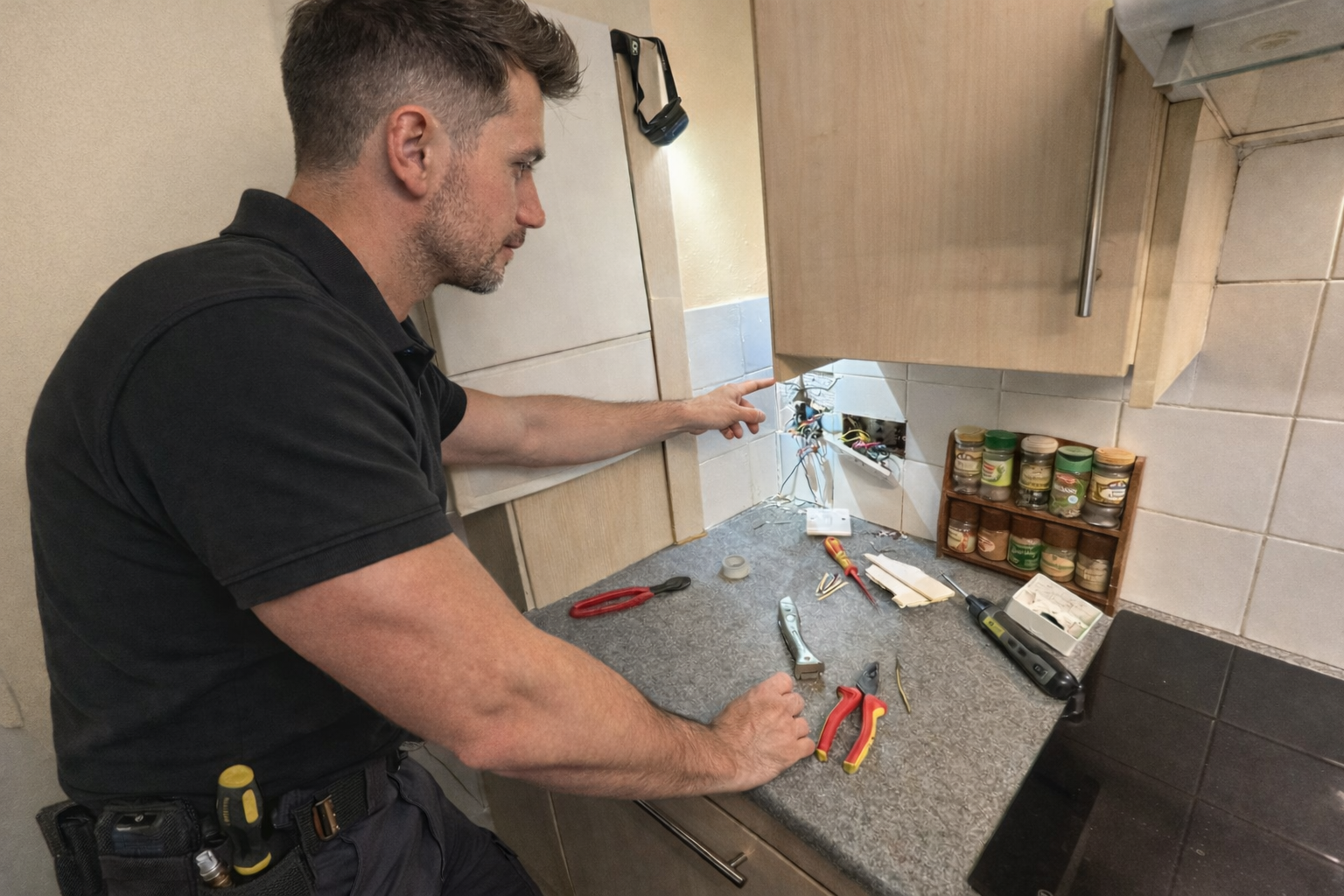
From below a lighting circuit looks simple: switch, cable, fitting, bulb. In practice it is a chain of connections hidden in ceiling voids, above insulation and inside switch boxes, often installed decades ago and extended since by several different people.
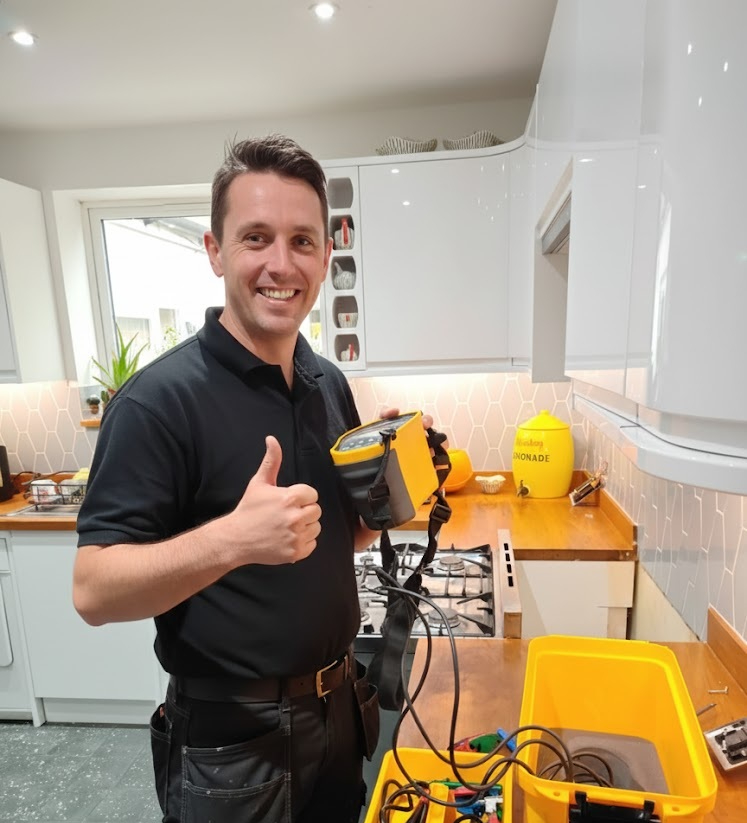
Repairing a lighting fault means working backwards from the symptom to the physical defect, then proving the repair with instrument tests rather than assuming it worked because the light came on. Every callout includes a visual inspection and circuit testing, and completed work is tested to BS 7671.
You need it whenever a lighting problem repeats, trips a protective device, produces heat or smell, involves water, or affects more than one fitting. One dead bulb is a bulb; anything beyond that is a circuit question.
FAULTS WE FIX
Usually the MCB or RCBO has operated, an older fuse has blown, or a terminal has worked loose at a ceiling rose, junction box or switch after decades of heating and cooling.
One fitting flickering points at that fitting, its holder or its driver. A whole circuit points at a shared connection, usually a loose neutral. The whole property dipping suggests a supply-side fault.
A lamp arcing internally as it fails trips a Type B MCB — harmless once. It is a real fault when it repeats, or the RCD trips with no lamp failing.
Usually compatibility: leading-edge dimmers chop the waveform sharply, and the harmonics make components inside the lamp vibrate. Dimmers also derate badly when ganged into one plate.
A tiny current still reaches the fitting, and an LED needs almost nothing to light up. Illuminated switches and dimmer standing current are nuisances; a borrowed or switched neutral is a real defect.
Thermal cut-outs doing their job. The fittings or drivers cannot shed heat — insulation over them, boarding across them, or a driver in a sealed void. A fire-safety issue.
Bathrooms are zoned under BS 7671, each zone needing a minimum IP rating. Where a rating is wrong or a seal has perished, moisture bridges live conductors to earth and the RCD trips.
Heat kills drivers — the capacitors inside dry out. Old halogen transformers often will not run 5W LED lamps at all, because the load sits below their minimum.
Landing and stair lights switch through a pair of strapper conductors. A break, loose terminal or failed switch leaves the light working from one position only.
WHAT WE HEAR
Lighting and sockets are separate circuits with separate protective devices, so this points at the lighting MCB, RCBO or fuse. A lighting circuit tripping again the moment you reset it means the fault is still there, so do not keep forcing it — see power loss and electrical tripping.
Genuinely useful, so do say it. Weather-dependent tripping is water finding a leakage path to earth in a fitting, joint, gland or damaged cable, and it will get worse.
Stop. Switch that light off, switch the lighting circuit off at the consumer unit and call us. Discolouration and burning smells mean heat where there should be none — see burning smells and dangerous electrics.
ROOT CAUSES
The commonest serious fault we find. A loose screw terminal creates resistance, resistance creates heat, and heat loosens the joint further. It shows as flicker, intermittent operation, warmth at the accessory, then discolouration.
Water in a fitting, a roof leak into a ceiling void, or degraded cable insulation creates a leakage path between live conductors and earth. Past a certain level the RCD trips — and because leakage varies with dampness, the fault comes and goes.
Recessed fittings, drivers and transformers need airflow. Insulation over downlights, boarded loft floors and sealed voids shorten component life dramatically and trigger thermal cut-outs.
Nails and screws through cables during flooring or loft boarding. Borrowed neutrals and junction boxes buried in inaccessible voids. Old rubber-insulated cable, hardened and crumbling at terminations — normal in older East Sussex housing.
HOW WE DIAGNOSE
Lighting faults are found by testing, not by swapping parts until the symptom happens to stop.
The full testing sequence is on our electrical fault finding page.
STEP BY STEP
SAFETY FIRST
Then ring us on 0333 360 8583 — straight away for a burning or hot-plastic smell, scorch marks, a fitting or dimmer hot to touch, sparking, water through a light, a tingle from a metal fitting, or a breaker that trips again the instant you reset it.
Leave the circuit off until an electrician attends if there is water ingress, a burning smell, scorching, or a device that trips again immediately. Losing one lighting circuit overnight is inconvenient; the alternatives are worse.
What follows depends entirely on what the testing finds. The realistic range:
Anyone pricing a lighting repair confidently before seeing it is guessing.
Location: Crowborough
Customer's problem: Downstairs lights flickering for several days, then out altogether.
Initial symptoms: Flicker getting worse over time, then the lighting breaker tripping and staying off.
Tests performed: Insulation resistance on the lighting circuit, then inspection of the ceiling roses and switch drops.
Fault discovered: A failed LED driver in a downlight had broken down to earth, and a loose connection at a ceiling rose had been causing the earlier flicker.
Repair: Failed driver replaced and the ceiling rose re-terminated.
Final testing: Insulation resistance, polarity and functional testing of all switching including the two-way circuit.
Outcome: Lighting stable again, with the remaining drivers checked for the same fault.
CALLOUT PRICING
The callout is a fixed price set by the time of day, covering attendance, a visual inspection and circuit testing. Any further work is quoted and agreed before it begins.
| Callout | When | Fixed price |
|---|---|---|
| Basic callout | 9:30am – 3pm, not guaranteed within the hour | £110 |
| Day callout | Daytime | £130 |
| Early evening callout | Early evening | £180 |
| Overnight callout | Overnight | £250 |
Prices shown are for the callout. Additional repair work, parts and materials are quoted and agreed before work begins.
What changes the final figure is the repair, not the attendance. A fault at an accessible switch is quick; one above a boarded loft floor or in a sealed ceiling void takes longer to reach, and ten downlights with a shared problem is a different job from one.
24/7 EMERGENCY LINE
We will tell you what it is likely to be, whether it needs attention today, and exactly what the callout costs — before we set off.
WHY POWER PROS
Intermittent lighting faults are the hardest kind to pin down. Testing locates them; replacing bulbs, fittings and dimmers until the symptom stops is not diagnosis, and you pay for every part tried.
Every visit includes a visual inspection and circuit testing, and completed work is tested to BS 7671. Part P registered, City & Guilds qualified.
We resolve 85% of emergency callouts on the spot — usually meaning the light works again before we leave, rather than a return visit and a second callout charge.
Bexhill-on-Sea, Hastings, Eastbourne and all of East Sussex, with a 1 hour response available. Insured to £2,000,000, with a 100% satisfaction guarantee.
CUSTOMER REVIEWS
“All ok the emergency electrician turned up in the stated time, overall happy with the service. 5 stars.”— Richard, Google review
“Great service, we will use them again. 5 stars.”— Brian Hearn, Google review
“Fast and efficient electricians, we would use them again.”— Connor, Google review
Reviews from our Google Business Profile, rated 5.0 from 10 reviews. Read them on Google.
COMMON QUESTIONS
A tiny current still reaches the fitting and an LED needs almost nothing to light up. Illuminated switches, two-way capacitive coupling, dimmer standing current or a borrowed neutral are the usual causes.
Compatibility, usually. Leading-edge dimmers suit filament loads; most LEDs need a trailing-edge type. You may also be below the dimmer's minimum load — four 5W LEDs is only 20W.
Most often a lamp arcing as it fails, which trips the MCB. If it repeats, or the RCD trips with no lamp blown, there is a fault to find.
A faint buzz is usually harmonics from the dimmer's switching. It matters once the dimmer is warm, discoloured or noticeably louder. Stop using it and have it replaced.
Thermal cut-outs are operating. The fittings or drivers cannot shed heat — usually loft insulation over the top, boarding across them, or a driver in a sealed void.
Only where the manufacturer declares the fitting suitable to be covered, and many are not. Fire-rated is not the same as safe to cover. Have it inspected.
Usually the fitting, not the bulb: poor contact in the lamp holder causing arcing and heat, an enclosed fitting cooking the lamp, vibration, or an unsuitable dimmer.
Steam or water is entering the fitting, because its IP rating is wrong for the zone or its seal has perished. Moisture leaks to earth and the RCD trips.
Water is getting in — a perished gasket, a loose gland, a joint in an unsuitable enclosure, or damaged buried cable. Weather-dependent tripping is a very useful clue.
Two-way switching uses a pair of strapper conductors between the switches. A break, loose terminal or failed switch leaves the light working from one position only.
The callout is fixed by time of day, £110 to £250, covering attendance, inspection and circuit testing. Further work is quoted first. We resolve 85% of emergency callouts on the first visit.
EXPLORE MORE
AREAS WE COVER
Power Pros cover Bexhill-on-Sea, Hastings, Eastbourne and towns right across East and West Sussex, 24 hours a day. Towns shown as a link have their own page; for anywhere else on the list, call 0333 360 8583 and tell us the postcode.
East Sussex
West Sussex
24/7 ACROSS EAST SUSSEX
A lighting fault that comes and goes is not fixing itself — it is waiting for the conditions that trigger it. Flicker, buzzing, warmth and lamps that keep failing are all symptoms of something physical, and every one is findable with the right tests. Bexhill, Hastings, Eastbourne and all of East Sussex, 24 hours a day.
